
Rent hits on the 1st. The electric bill lands on the 8th. Groceries can’t wait until the 30th. If you’re paid twice a month, you know that awkward stretch where your bank balance says no even though you’ve already worked the hours.
That’s why jobs that pay weekly feel different. You work Monday through Friday, money lands the following Friday. Short cycle, fewer gaps, easier to plan. No magic, just faster cash flow.
At Luck & Fortune Finance, we’ve looked at dozens of payroll setups across warehouses, restaurants, staffing agencies, and gig platforms. The truth is weekly pay is common, but it doesn’t work the same everywhere. Some jobs pay every Friday like clockwork. Others advertise “weekly payouts” that come with fees, holds, or minimums. Here’s how it really works, which job categories most often pay weekly, and how to vet an offer before you count on that first check.
How to Use This Guide
Start with how the pay cycle actually works so a “weekly pay” posting doesn’t surprise you. Then jump to the five job categories where weekly payroll shows up most often, use the vetting checklist before you accept anything, and finish with a simple way to split each check so the fifth Friday doesn’t empty the account.
How weekly pay actually works
Weekly pay sounds simple: work a week, get paid. In practice, there’s almost always a lag.
For a traditional W-2 job, most employers run payroll in arrears. You work Week 1, payroll processes early Week 2, and your direct deposit arrives late Week 2. So your first paycheck after starting might take 10-14 days, then it settles into a weekly rhythm. That’s normal, not a scam. Ask on day one: “When does the pay week end, and what day do deposits hit?”
True weekly salary jobs follow that same cycle. Your hourly rate or salary is divided into 52 paychecks. Taxes, benefits, and any garnishments come out each time, so each check is smaller than a biweekly check but you get more of them. Overtime is usually calculated on the same 7-day workweek.
Gig and app payouts are different. Delivery, rideshare, grocery shopping, and freelance platforms often offer weekly payouts as the default, with an option for instant cash-out for a small fee. The money isn’t processed through traditional payroll. The platform batches your earnings and sends them to your bank, usually taking 1-3 business days. If you cash out instantly, you often pay $0.50 to $1.99 per cash-out, sometimes plus a percentage — check your app, fees change often. Those fees add up if you use instant pay every day.
There are also hybrid setups. Temp and staffing agencies will often pay W-2 warehouse and light industrial workers weekly, even if the warehouse itself pays its direct hires biweekly. The agency is your employer of record, so you follow the agency’s schedule. Same work, different pay cycle.
Two practical notes:
First, “paid weekly” doesn’t mean paid immediately. Even the best weekly setup has processing time for your first check. Plan for at least one full pay cycle of expenses before you start.
Second, pay frequency can vary by employer, franchise, and payroll provider — even within the same chain. A store in Texas might pay weekly while one in California pays biweekly. Always confirm with the specific store, franchise, or branch — not just the corporate careers page.
For general background on how states handle payday timing, you can browse the Department of Labor’s roundup of state payday requirements (a historical table — consult your state labor office for current rules).
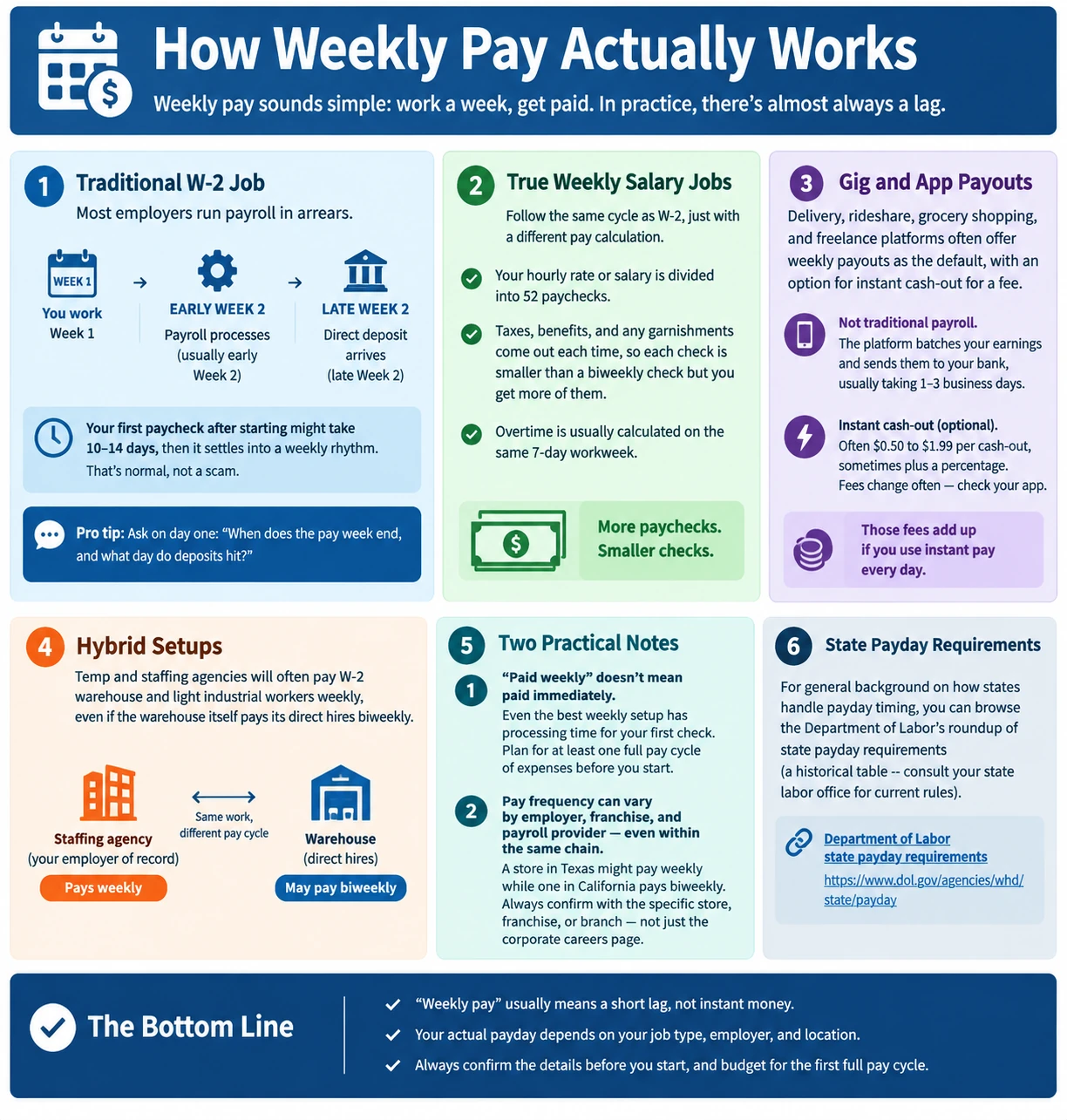 Weekly payroll still has a lag. Plan for one full pay cycle of expenses before your first deposit lands.
Job categories that commonly pay weekly
No category guarantees weekly pay. Every employer sets its own payroll. But if you want jobs that get paid weekly, these five categories are where we see it most often. If you mostly want gig top-ups rather than payroll jobs, see our guide to side hustles that pay weekly — this piece focuses on weekly-payroll jobs.
1. Temp and staffing agency roles, especially warehouse and light industrial
If you need a weekly paycheck fast with no degree, staffing agencies are one of the most reliable paths.
Agencies place workers in warehouses, fulfillment centers, packaging, assembly, sorting, and event setup. Many pay weekly by default because that’s how they stay competitive for hourly workers. You might work at the same building for months while technically employed by the agency.
Pay is usually $15 to $22 per hour for entry-level picking, packing, and loading, higher for forklift or lead roles and night shifts. Tradeoffs are real: schedules can change weekly, assignments can end with short notice, and benefits are thinner than direct-hire roles. Some temp-to-hire roles convert after about 90 days, many don’t — ask about conversion terms before you count on it.
To find them, search for staffing agencies plus your zip code, or look at warehouse jobs near you to see what shifts and pay ranges look like in your area. When you apply, ask three things: Who is the employer of record? What day is payday? Is there a pay card fee if I don’t have direct deposit?
This is a good fit if you can do physical work, want overtime, and prefer a set schedule over hustling for orders on an app.
2. Delivery, rideshare, and grocery gigs with weekly payouts
App-based delivery is one of the most accessible ways to get on a weekly payout cycle without an interview process.
Most major delivery and grocery apps default to a weekly payout to your bank, with instant pay as an optional add-on. You can often start earning within a few days after background check and vehicle approval, then receive your first batch payout the following week. Earnings vary a lot by market, car costs, and time of day. Lunch and dinner rushes, weekends, and bad weather tend to pay better, but gas, mileage, and wear-and-tear come out of your pocket.
We compared current options in our breakdown of delivery apps to work for. Look closely at base pay versus tips, acceptance rate pressure, and how schedule releases work in your zone. One app might be best for dinner orders downtown, another for suburban grocery batches.
Weekly pay helps here because you can test a schedule for one week, see the actual deposit, then adjust. Track miles from day one. Drivers who don’t track mileage often overestimate profit. And avoid running instant cash-out daily unless you actually need it — that $1.99 fee five times a week is about $40 every four weeks.
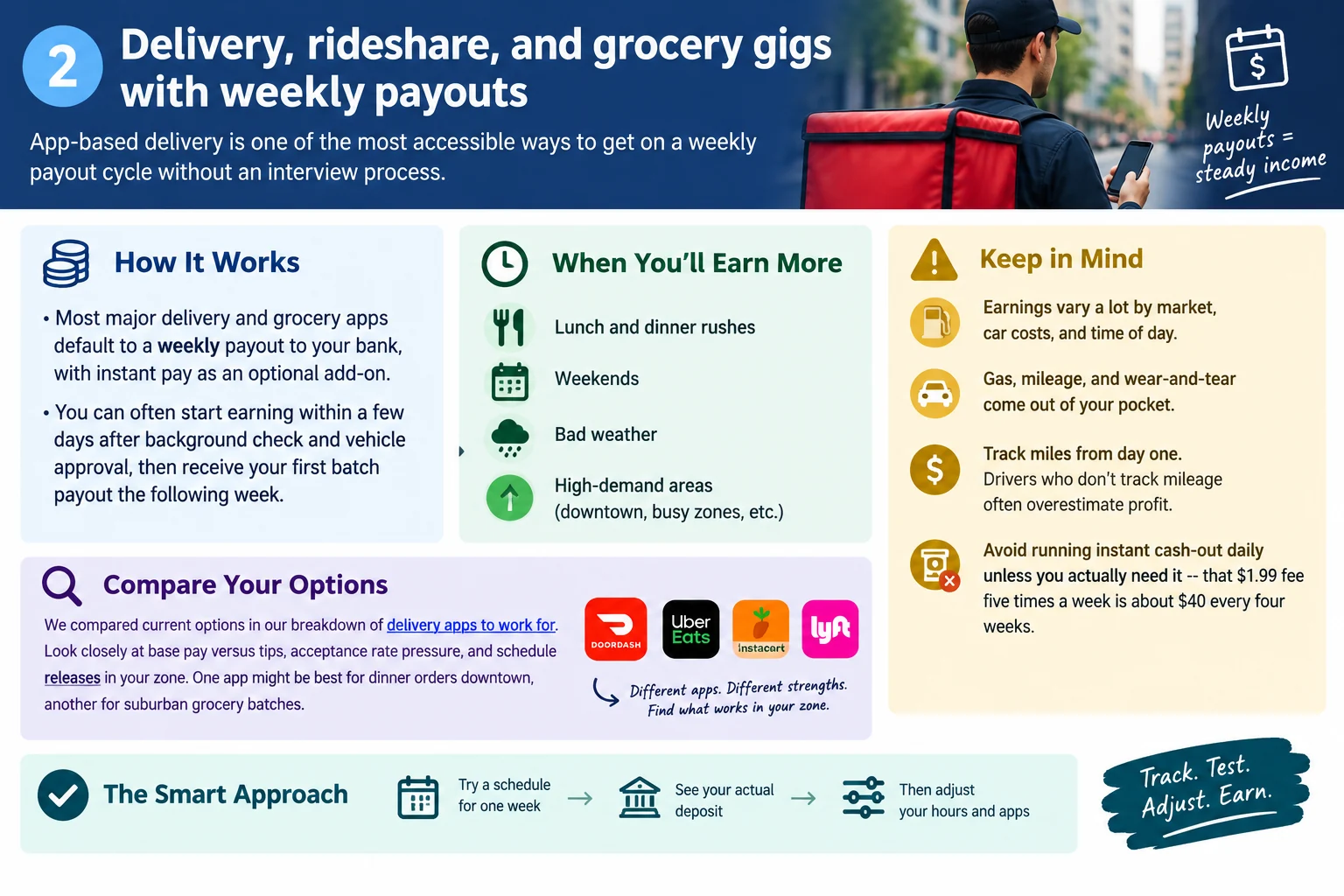 Most apps default to a weekly bank payout — instant cash-out is the optional, fee-based add-on.
3. Food service, catering, and hospitality
Serving, bartending, barista work, line cook, dishwasher, hotel housekeeping, and catering staff very often land on weekly payroll, especially in independent restaurants and catering companies.
There are two income streams to understand: hourly base plus tips. The hourly base arrives on the weekly paycheck. Cash tips go home same night. Credit card tips may be added to your paycheck or paid out in cash at shift end, depending on the house policy. That policy matters a lot for cash flow, so ask.
Hourly rates look low on paper — often $10 to $16 plus tips for front-of-house in many markets, $14 to $19 for back-of-house — but a busy Friday and Saturday can double your take-home. The tradeoff is schedule volatility. Slow weeks in January or a rainy patio season mean lean checks. Weekly pay smooths this a bit, but it doesn’t fix seasonality.
Catering and banquet work is worth a special mention. Staffing for weddings and corporate events is often weekly, shifts are posted in an app or group chat, and you can pick up extra shifts around holidays. It’s physical, nights and weekends are expected, and shoes matter more than you think.
If you’re already working retail or food service biweekly and want weekly, you don’t always need to change industries. Sometimes switching from a corporate-owned store to a franchisee, or from one restaurant group to another across the street, changes your pay frequency. Ask before you apply.
4. Home care, cleaning, childcare, and other care jobs
Care work is steady, local, and frequently paid weekly — particularly through home-care agencies, cleaning companies, and childcare centers.
Home health aides, personal care aides, cleaners, nannies placed through agencies, and daycare assistants often earn $14 to $20 per hour, with slightly higher rates for nights, weekends, or specialized experience. Many agencies pay weekly because turnover is high and weekly pay helps retention. Private clients paying cash or via apps like Venmo or Zelle can feel weekly, but you lose worker protections and tax documentation, so weigh that carefully.
This path suits people who want consistent daytime hours and don’t want warehouse strain or late-night driving. Requirements are usually a background check, reliable transport, and sometimes a CNA certificate, food handler card, or CPR training. Some agencies will reimburse training if you commit to a schedule.
One caution: private listings that promise unusually high weekly rates for light babysitting or “care companion, no experience, $1,200/week” deserve extra scrutiny. Real care jobs pay solid but not fantasy rates, and real agencies have an office, onboarding paperwork, and a clear payday schedule.
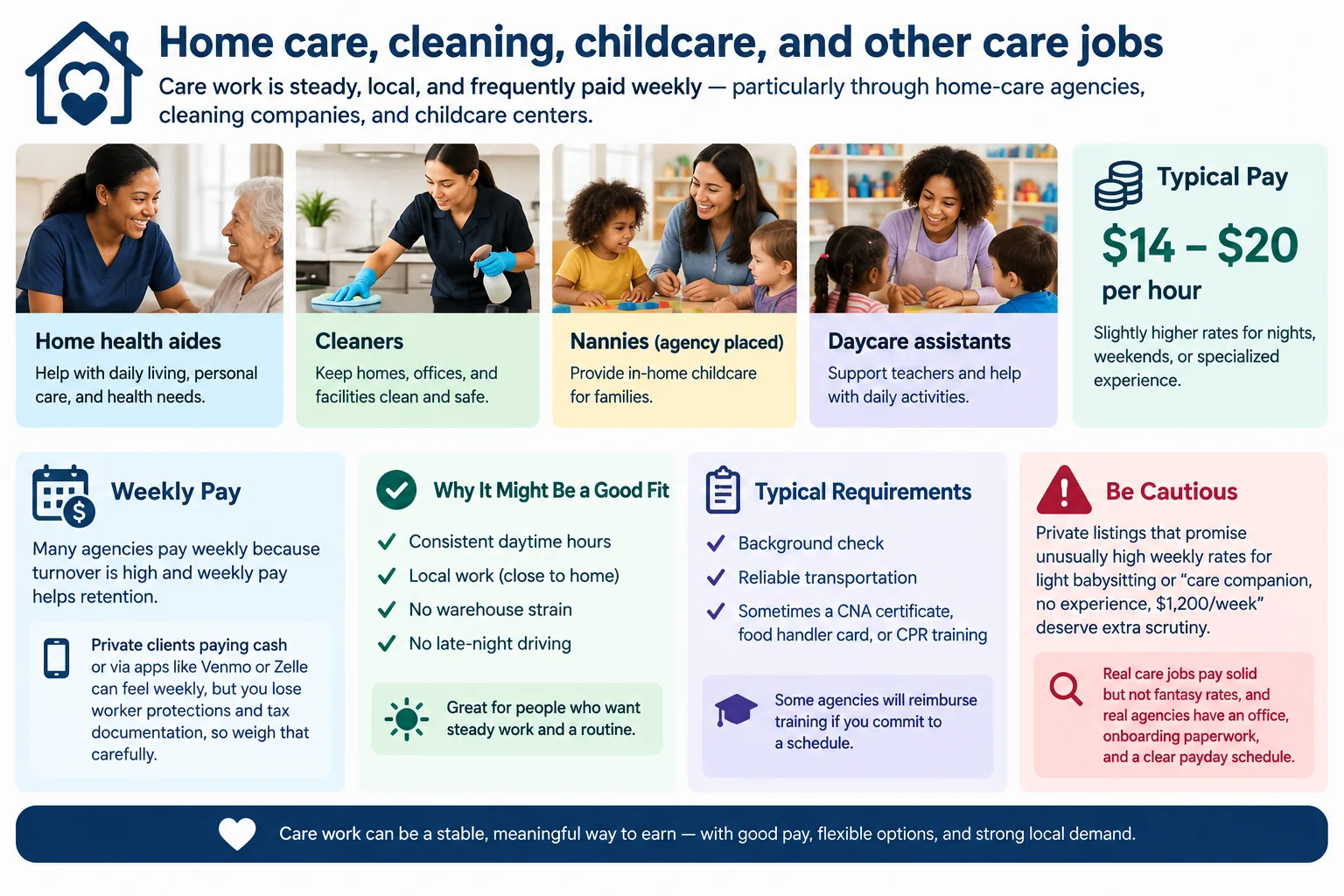 Agencies often pay weekly to hold onto staff — private cash clients feel weekly too, but lose protections.
5. Retail, call center, and freelance work with fast payouts
Retail and customer support are mixed — some chains pay weekly, others biweekly. Big-box seasonal hiring, grocery chains, and inbound call centers are more likely to offer weekly payroll during peak hiring. If you see a posting for a weekly paid job at a retailer, confirm whether that applies to part-time and seasonal staff too, not just management.
Freelance work is the other fast-payout option. Marketplaces for writing, design, bookkeeping, virtual assistance, and handyman services typically release funds weekly after client approval, with faster withdrawals for a fee. Rates are higher per hour than warehouse or retail, but work isn’t guaranteed. You trade a steady schedule for control and have to handle self-employment taxes.
For a low-barrier starting point, browse part-time jobs you can start today and filter for employers in your area that list weekly pay in the job description. Pair one stable base — even 20-25 hours at a store or warehouse — with one flexible top-up like weekend delivery or one freelance client. That combo gives you both predictability and upside.
Offer VettingHow to vet a weekly-pay offer before you count on it
Searching for weekly payment jobs near me will surface hundreds of listings from companies that pay weekly. Some are accurate. Some use “weekly pay!” as clickbait for commission-only sales or fee-based programs. A 10-minute vetting routine saves you a wasted week.
Start with the listing language. Legitimate companies that pay weekly usually state the pay cycle plainly: “Payday every Friday, direct deposit, pay week runs Sun-Sat.” Vague phrases like “earn up to $2,000/week,” “daily payouts available,” or “be your own boss, unlimited income” without a base rate are marketing, not payroll details.
Then ask these five questions before you accept:
What day is payday, and what week does it cover?
Are workers W-2 employees or 1099 contractors?
Is weekly pay standard, or only with a pay card / instant-pay fee?
Are there holds, minimums, or waiting periods for the first check?
How are overtime, tips, and bonuses paid — same check or separate?
Red Flags to Walk Away From
To verify local options, cross-check three places: the company’s own careers page, the specific franchise or staffing branch Google listing with recent reviews from workers, and the job posting date. If a post says “weekly pay near me” but reviews from the last two months mention late checks or pay-card fees, believe the workers.
Finally, keep records. Screenshot the posting that promised weekly pay, save your offer letter, and photograph your schedule. If payday slips, you have dates to reference when you contact payroll. Most issues are admin errors and get fixed quickly when you have specifics.
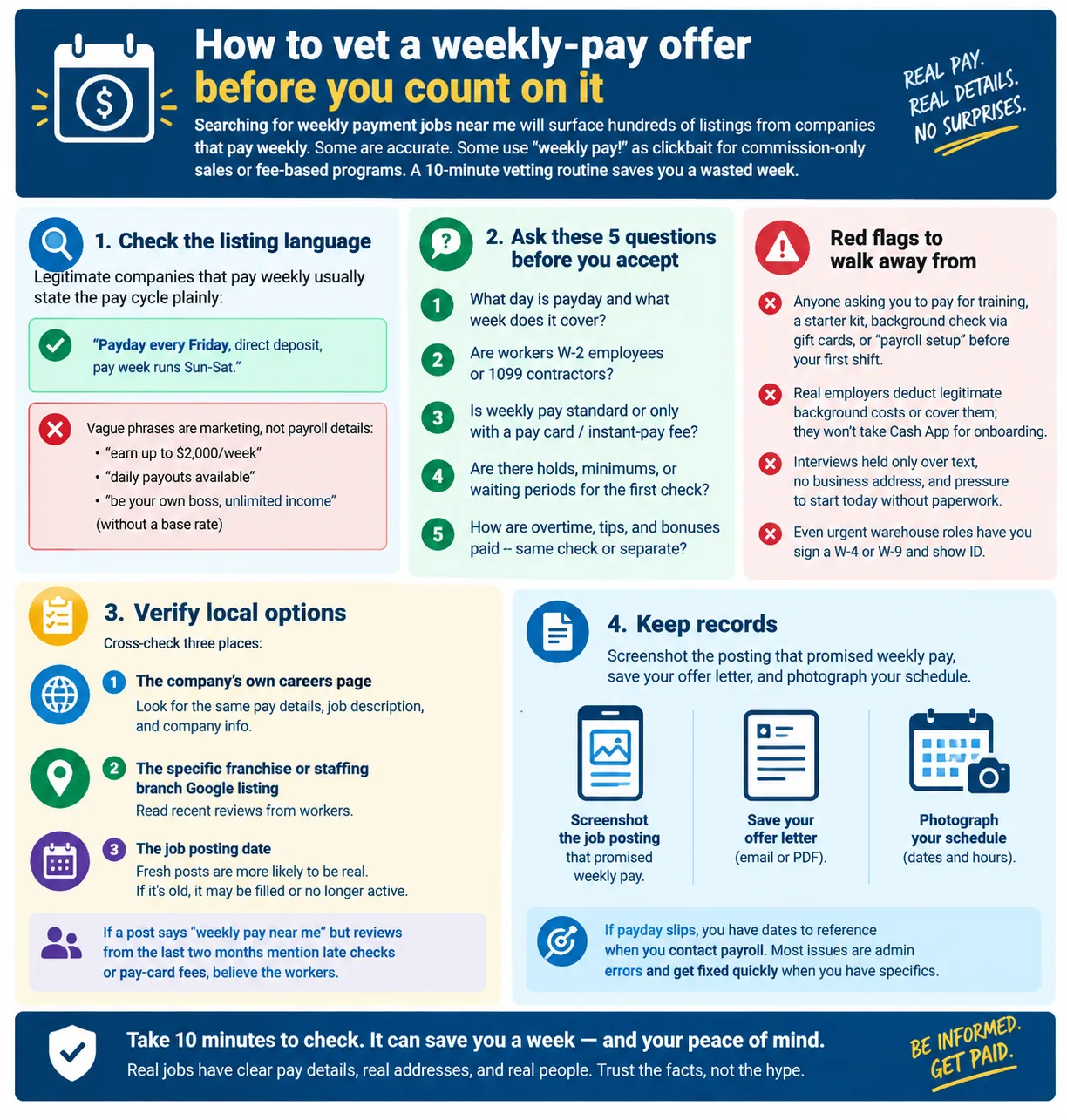 Plain payday language is the sign of a real offer — vague income promises are marketing, not payroll.
Making a weekly paycheck stretch
Weekly paycheck jobs solve timing, not budgeting. Four smaller checks can actually feel tighter than two bigger ones if you don’t assign each check a job. A simple split works for most people.
Try a 50/30/20 rhythm per check as a starting point:
About Half → Fixed Bills
Rent, car insurance, phone, and utilities. If rent is due on the 1st, set aside a quarter of rent from each Friday check so four checks cover it.
~30% → Variable Essentials
Groceries, gas, and household costs that move week to week. Track one week honestly before you set the number.
~20% → Buffer and Debt
Split between a small cash buffer and extra debt payments. Keep the buffer boring — regular savings, not investments.
On a $520 weekly take-home, that’s roughly $260 to rent/bills, $155 to essentials, and $105 to buffer/debt. Adjust the percentages to your rent level, but keep the habit of splitting every check the same day it lands.
Time your bills to your paydays. If rent is due on the 1st and you get paid every Friday, set aside a quarter of rent from each Friday check in a separate account or envelope. Same for car insurance and phone. You avoid the classic weekly-pay trap where the fifth Friday feels rich and the first week of the month feels broke.
Build a one-week buffer as your first goal, not a full emergency fund. One week of bare-bones expenses in savings means a late deposit, reduced hours, or a sick day doesn’t trigger overdraft fees. Keep it boring and accessible — regular savings, not investments.
We track our own test paydays and bill splits with the checklists in our Side Hustle Toolkit — mainly to see which Friday covers which bill without guessing.
And if hours get cut one week, act that same day. Pick up one catering shift, run one dinner rush, or ask your staffing coordinator about weekend coverage. Weekly pay rewards fast responses because next Friday is always close.
FAQ: Jobs That Pay Weekly
Weekly pay is common across staffing agencies, delivery apps, restaurants, care work, and some retail — but it never means instant money. Confirm the pay cycle in writing, ask whether fees or holds apply, and split every check the day it lands. Frequency solves timing; your effective hourly rate solves income.
Related Resources

Track Every Payday in One Place
Log the offer, the pay cycle, and each Friday deposit so nothing slips. Our free Side Hustle Toolkit helps you match which check covers which bill, watch for cash-out fees, and keep weekly payroll jobs organized.
Get the Free Chrome Extension