The AI gold rush created something surprising: a legitimate side hustle that pays real money and requires zero coding skills. While developers build the models, an army of regular people trains them—and they're getting paid for it.
We've investigated hundreds of online earning opportunities at Luck & Fortune Finance, from survey platforms to virtual assistant work. AI tutor jobs sit in a sweet spot: more engaging than repetitive micro-tasks, more accessible than technical AI roles, and genuinely remote without the feast-or-famine instability of freelancing.
This isn't about building AI. You won't write algorithms or train neural networks. AI tutors provide human feedback—rating responses, identifying errors, and teaching models what good answers look like. If you can write clearly, follow detailed instructions, and spot when something sounds off, you can do this work.
Here's the complete picture: what AI tutors actually do, which platforms are legitimately hiring, what you'll earn, and how to spot the scams that inevitably appear around any new opportunity.
What Do AI Tutors Actually Do?
The term "AI tutor" creates confusion. You're not teaching artificial intelligence to students—you're teaching the AI itself. The technical term is RLHF: Reinforcement Learning from Human Feedback. Breaking that down: AI models learn from examples, and humans provide the quality judgments those models need to improve.
The Actual Work
Rating AI responses. You'll see a prompt (a user question or task) and two or more AI-generated responses. Your job: pick the better one, or rank them from best to worst. The model learns which outputs humans prefer.
Writing example responses. Some tasks ask you to write the "ideal" answer to a prompt. The AI studies your response to learn patterns of good writing, accurate information, and appropriate tone.
Identifying errors. You'll review AI outputs and flag factual mistakes, harmful content, logical inconsistencies, or responses that miss the user's actual intent. This teaches the model what not to do.
Comparing outputs. Side-by-side evaluations help models understand subtle quality differences—why one helpful response ranks higher than another that's technically correct but less useful.
Specialized subject work. Platforms increasingly need tutors with expertise in math, coding, science, medicine, law, or languages. You'll verify AI responses in your field, ensuring accuracy where it matters most.
What You Won't Do
No programming. No data science. No building chatbots or fine-tuning models. The technical infrastructure is handled by engineers. Your role is the human judgment layer—the quality control that automated systems can't replicate.
Work Structure
Most AI tutoring is project-based rather than a traditional job. You'll log into a platform, claim available tasks, and work as much or as little as you want. Some platforms offer consistent weekly work; others operate in bursts—heavy availability when new models need training, quieter periods between projects.
The flexibility is genuine. Work early mornings, late nights, or weekends. Fit tasks around another job, parenting, or school. But the tradeoff is unpredictability. Income varies week to week based on task availability and your speed at completing assessments.
Top Platforms Hiring AI Tutors
Not all platforms are equal. Some pay reliably; others waste your time. We've dug into dozens of options to find the legitimate opportunities with real earning potential.
Mindrift.ai
What they do: Data labeling and AI training across multiple task types—ranking responses, categorizing content, verifying facts, and providing written feedback.
Pay range: $15-25/hour for general tasks; specialized work (medical, legal, technical) can reach $30-40/hour.
Requirements: Strong English writing skills, attention to detail, and the ability to follow complex guidelines. Some projects require subject-matter tests or credentials verification.
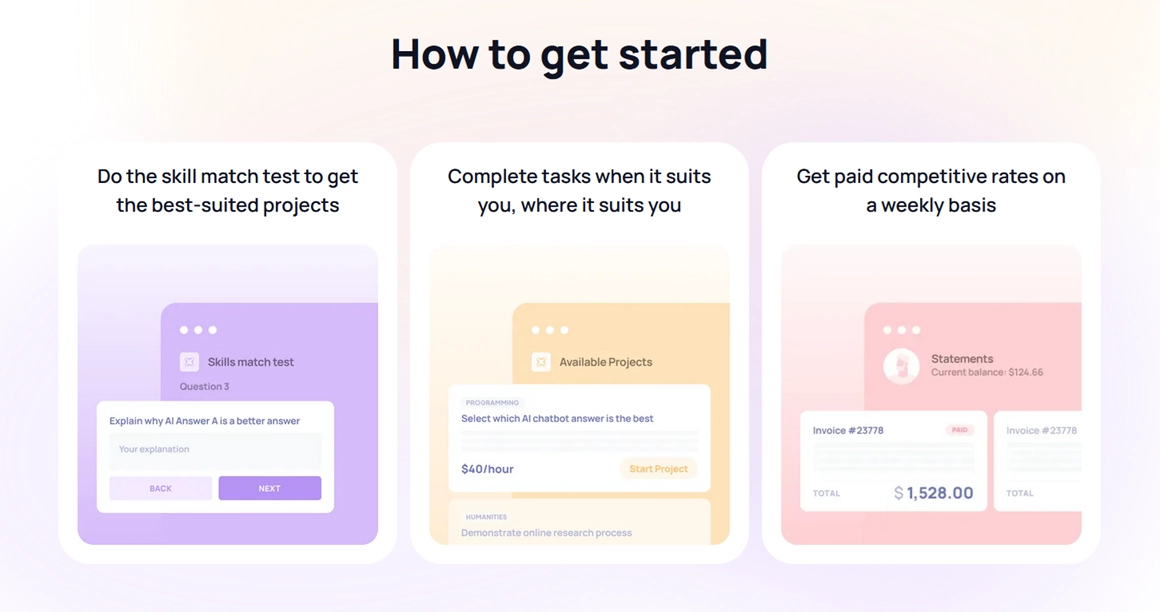
How to apply: Create a profile on mindrift.ai, complete assessment tests for available projects, and claim tasks that match your qualifications. The application process involves sample tasks that test your ability to follow instructions precisely.
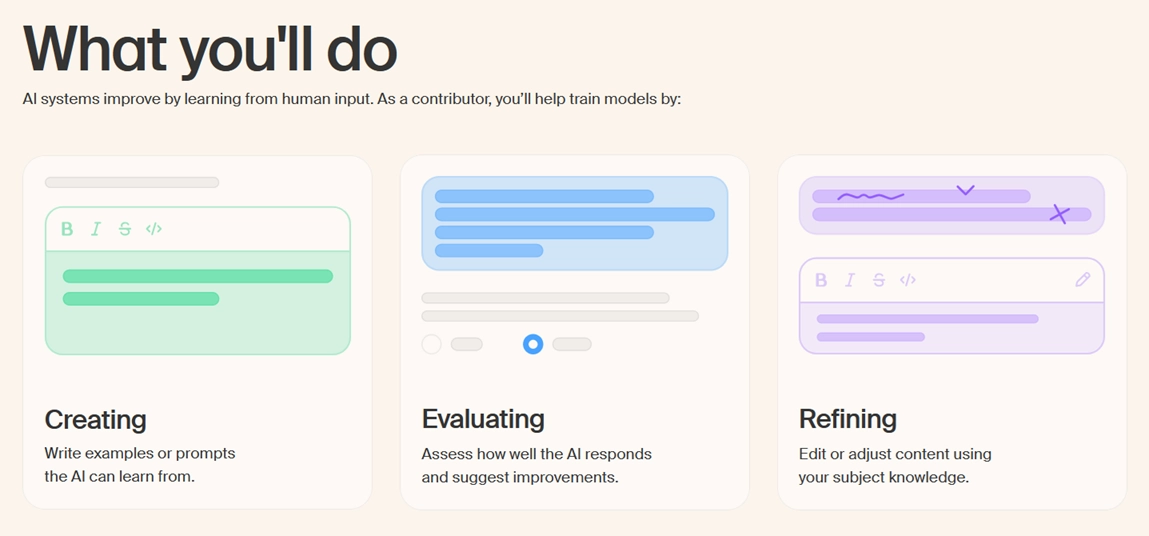 Mindrift.ai offers diverse AI training tasks ranging from general response ranking to specialized subject verification.
Outlier.ai
What they do: AI tutoring with a focus on subject-matter expertise. They actively recruit people with degrees or professional experience in specific fields.
Pay range: $30-50/hour for verified experts; entry-level work starts around $20/hour.
Requirements: Varies by project. Many require degree verification, professional certifications, or demonstrated expertise. Writers, editors, educators, and technical professionals are frequently recruited.
How to apply: Apply through outlier.ai with your credentials. The platform matches you to projects fitting your background. Expect a multi-stage application including identity verification and subject-area testing.
RWS TrainAI
What they do: Community-based AI training with diverse task types. Part of RWS Group, a larger language and content services company with established credibility.
Pay range: $15-30/hour depending on task complexity and language.
Requirements: Native-level language skills, attention to detail, and reliable internet. Some tasks require specific demographics or subject knowledge.
How to apply: Join through the RWS TrainAI portal. The process includes language assessments and sample tasks. Once approved, you'll access a dashboard of available training projects.
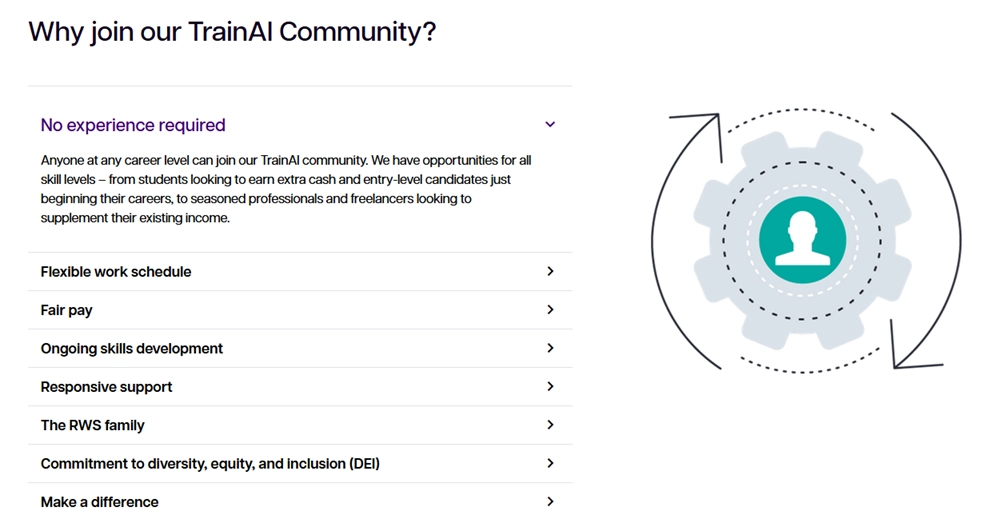 RWS TrainAI is part of the established RWS Group and offers community-based AI training with diverse project types.
Handshake Fellowship
What they do: Entry-level AI training specifically designed for students and recent graduates. Lower barriers to entry with built-in learning resources.
Pay range: $30-125/hour depending on your expertise level. Specialized roles (software engineering, finance, medicine) pay significantly more than general tasks.
Requirements: Currently enrolled student or recent graduate status, basic computer skills, and strong written communication. No subject expertise required for entry-level tasks, but specialized knowledge unlocks higher rates.
How to apply: Apply through the Handshake platform (the college job board). The fellowship program includes training modules before you start paid work, making this genuinely beginner-friendly.
Stellar AI
What they do: Tutoring-focused AI training, with emphasis on educational content and instructional quality.
Pay range: $20-35/hour, with higher rates for educators and curriculum specialists.
Requirements: Background in education, tutoring, or instructional design preferred. Strong writing and explanation skills essential.
How to apply: Submit an application through Stellar AI's website with your resume and subject areas of expertise. The vetting process emphasizes teaching ability over technical knowledge.
 Stellar AI emphasizes educational content quality and prioritizes teaching experience over technical knowledge.
Other Platforms to Consider
DataAnnotation.tech — General data labeling with consistent task availability. Rates typically $15-25/hour for general work, $30-45/hour for coding tasks.
Remotasks — Owned by Scale AI, offers various data labeling and AI training tasks. Pay ranges from $3-7/hour for basic tasks up to $20-50/hour for specialized work like LiDAR or coding. Available internationally.
Surge AI — Premium platform requiring demonstrated expertise. Generalist rates around $18-25/hour, but domain experts (medical, legal, technical) can earn $250-1,000+/hour.
Pay Rates: What to Expect
Let's talk numbers honestly. AI tutor pay varies dramatically based on your speed, task complexity, and whether you qualify for specialized work.
Entry-Level Earnings ($15-25/hour)
New tutors working general tasks typically earn $15-25 per hour—if you're efficient. The catch: "hourly" pay is often calculated per task. A task paying $0.50 might take two minutes or five minutes depending on your speed and the complexity. Early on, expect to earn toward the lower end as you learn interfaces and guidelines.
At 15 hours weekly with consistent task availability, that's roughly $350-550 monthly. Not life-changing money, but meaningful side income.
Subject Matter Expert Rates ($30-50/hour)
Verified expertise commands premium rates. If you have a degree in computer science, medicine, law, or engineering, specialized AI tutoring can reach $30-50/hour. These projects verify your credentials and require maintaining high accuracy scores.
At 20 hours weekly of specialized work, monthly earnings can reach $2,000-3,500. Some full-time tutors report higher figures, though consistency depends on project availability.
Project-Based vs. Hourly Structures
Most platforms use project-based pay: you earn per task completed, not per hour logged. This rewards efficiency—skilled tutors working quickly can exceed standard hourly rates. But it also means unpaid learning time as you master new guidelines.
A few platforms (Outlier, some RWS projects) offer true hourly contracts with minimum commitments. These provide income stability but less flexibility in when you work.
Payment Methods and Timing
Pay varies by platform: PayPal, direct deposit, Wise, or crypto (rare). Most pay monthly or biweekly. Some hold earnings until you reach minimum thresholds ($10-50). Factor in processing delays—earnings in January might not reach your bank until February.
Realistic Monthly Potential
Consistent part-time work (15-20 hours weekly) at entry-level rates generates $400-800 monthly. Specialized work at higher commitment (25-30 hours) can reach $1,500-3,000 monthly when projects are available.
The variability matters. Some months offer abundant tasks; others are sparse. Don't depend on AI tutoring for essential expenses until you've established consistent access to work.
Requirements & Skills Needed
The barrier to entry is genuinely low, which makes this accessible but also competitive.
What You Don't Need
No coding. This cannot be emphasized enough. You don't need Python, JavaScript, or any programming knowledge. The engineers handle the technical implementation; you provide human judgment.
No advanced degree. While specialized projects require credentials, many entry-level tasks need only strong writing and attention to detail.
No AI background. You'll learn the specific guidelines each platform requires during onboarding.
What You Do Need
Strong written communication. Your entire job involves reading and writing. You must understand nuanced instructions and produce clear, grammatical responses.
Attention to detail. Following guidelines precisely matters more than speed. Platforms track accuracy scores; consistent errors result in removed access.
Computer and reliable internet. A laptop or desktop (not just phone), stable high-speed connection, and a quiet workspace for concentration.
Time flexibility. Task availability is unpredictable. The tutors who earn consistently check platforms frequently and work when tasks appear.
Patience for repetitive work. Rating the 50th AI response requires the same care as the first. If repetitive detail work drains you, this won't suit you.
Additional Requirements (Platform-Specific)
Some platforms require:
- Degree verification or transcripts
- Subject-area proficiency tests
- Background checks (especially for sensitive content)
- Age verification (most require 18+)
- Location restrictions (some US-only, others international)
Check requirements before investing time in applications.
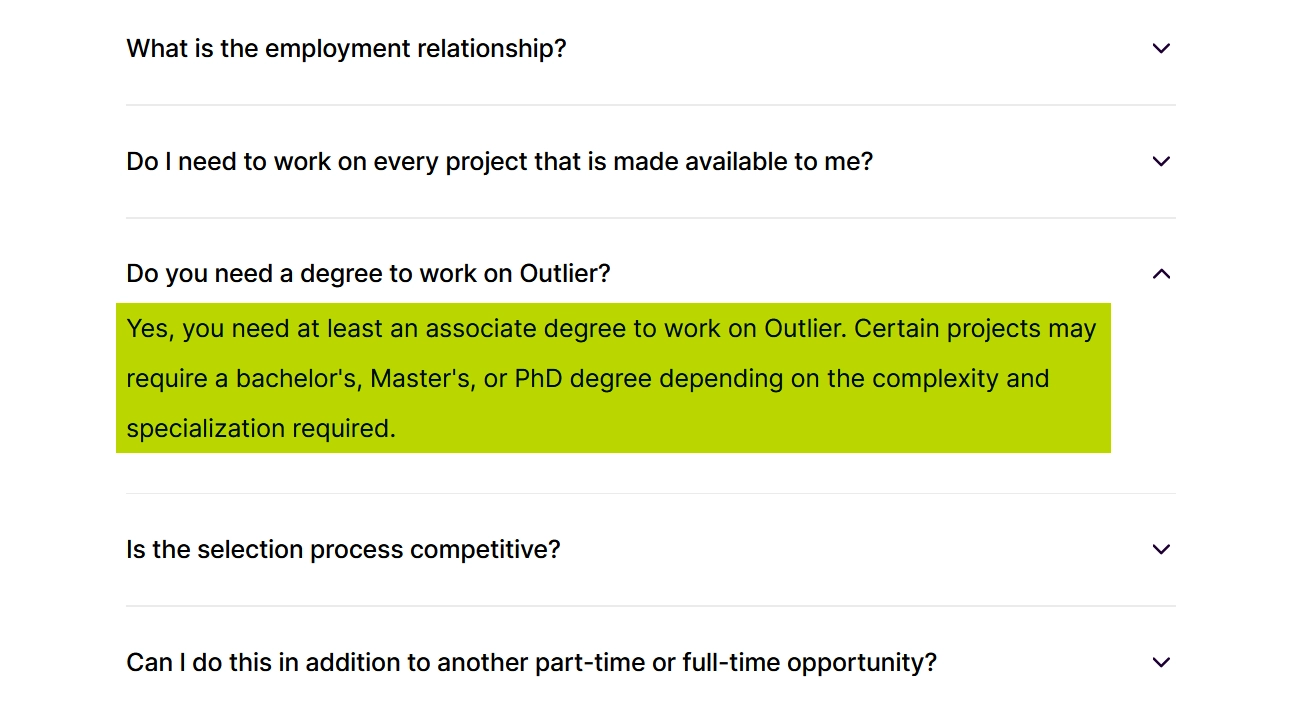 Outlier.ai focuses on subject-matter expertise and requires a degree to work on the platform
Getting Started: Step-by-Step
If AI tutoring interests you, here's the practical path forward:
1. Pick 2-3 Platforms
Don't shotgun applications to every platform. Research which match your background:
- Students/recent grads: Start with Handshake Fellowship
- Educators/writers: Prioritize Outlier, Stellar AI
- Generalists with strong English: Mindrift, RWS TrainAI
- International applicants: Remotasks, DataAnnotation (check country availability)
Applying to 2-3 platforms lets you compare interfaces, pay rates, and task availability before committing.
2. Complete Assessments Seriously
Every legitimate platform tests applicants with sample tasks. These aren't formalities—they're filters. Read guidelines carefully. Double-check your work. Rushed applications get rejected.
3. Build Your Profile
Add credentials, degrees, professional experience, and subject expertise. Even if not required, verified backgrounds unlock higher-paying projects. Some platforms let you retake assessments to qualify for advanced work.
4. Start Small
Your first tasks will feel slow. You're learning interfaces, interpreting guidelines, building speed. Don't quit because initial hourly calculations look disappointing. Speed improves with practice.
5. Scale Up Gradually
Once comfortable on one platform, add a second for task diversification. Track your effective hourly rate across platforms. Some offer better pay but sporadic work; others provide consistency at lower rates. Optimize your mix.
Red Flags to Avoid
New opportunities attract scams. Protect yourself by recognizing warning signs:
Upfront Payment Requests
Legitimate AI training platforms never charge application fees, training costs, or equipment purchases. If you're asked to pay anything before earning, it's a scam.
Unrealistic Pay Claims
Promises of "$100+/hour with no experience" or "$5,000 monthly part-time" are fiction. Entry AI tutoring pays modestly. High earnings require expertise, efficiency, and consistent availability.
Vague Job Descriptions
Real platforms explain exactly what tasks involve. Scams use buzzwords ("AI training opportunity," "work with cutting-edge technology") without specifics about what you'll actually do.
Requests for Personal Information Early
Never provide Social Security numbers, bank details, or identification copies during initial applications. Legitimate hiring completes these steps after you've been selected, through secure portals.
MLM or Pyramid Structures
Some schemes disguise themselves as AI training but focus on recruiting others. If earnings come from referrals rather than actual task completion, walk away.
Pressure Tactics
"Limited spots," "apply today only," or aggressive recruitment are red flags. Legitimate platforms maintain ongoing applications; they don't create artificial urgency.
Before applying, research platforms on Reddit, Glassdoor, and Trustpilot. Legitimate opportunities have user reports of actual earnings; scams have complaints about unpaid work or disappeared platforms.
Conclusion
AI tutor jobs represent a real, accessible entry point into the AI economy. You don't need a computer science degree or technical background. You need strong writing, attention to detail, and willingness to learn platform-specific guidelines.
This work suits people who:
- Want flexible, location-independent income
- Enjoy detail-oriented tasks and written communication
- Can handle income variability without financial stress
- Have 10-20 hours weekly to dedicate
It doesn't suit people who:
- Need guaranteed, consistent weekly earnings
- Find repetitive evaluation work mentally draining
- Lack patience for detailed guidelines and quality standards
If you're organized, communicative, and curious about AI without wanting to become a programmer, this is worth exploring. Start with one application this week. Complete the assessments carefully. Give yourself time to learn the interface before judging whether the work suits you.
The AI economy needs human judgment. That need creates opportunity—for now, still accessible to regular people willing to do quality work.
Have you tried AI tutoring or data labeling work? Which platforms have you applied to, and what was your experience? We'd love to hear about it in the comments below.
FAQ: AI Tutor Jobs
Related Resources

Organize Your Side Hustles
Track your AI tutor earnings alongside other income streams with our free Side Hustle Toolkit.
Get the Free Toolkit