Nobody hiring a designer in 2026 asks about your degree first. They open your portfolio, and they've usually decided within thirty seconds whether to keep reading. The credential conversation happens later, if it happens at all. That means the real bottleneck in a design job search isn't proving you can design — it's finding the listings worth applying to, because graphic design jobs are scattered across general job boards, design-specific marketplaces, freelance platforms, and staffing agencies, and each channel rewards a different approach.
Whether you're hunting your first junior role or your fifth freelance client, the play is the same. We'll compare the three main channels where design work gets posted, show what the pay actually looks like right now with real Bureau of Labor Statistics numbers, and finish with a week-by-week plan for your first thirty days of searching. No "follow your passion" filler.
The MarketThe Graphic Design Jobs Market Right Now
Start with the honest numbers. According to the Bureau of Labor Statistics' Occupational Outlook Handbook, about 265,900 graphic designers were employed in the US in 2024, earning a median of $61,300 per year. Employment is projected to grow just 2% through 2034 — slower than the average job — but that statistic misleads more than it informs. The BLS still projects roughly 20,000 openings per year over the decade, because designers constantly retire, switch careers, or move into adjacent roles. The field isn't booming, but the listings never stop.
Two structural shifts matter more than the headline. First, remote work is now standard: remote graphic design positions are common, and a growing share of remote graphic design jobs are contract rather than staff roles. Second, demand has tilted digital. Digital design jobs — UI, web, product, motion — pull the strongest salaries, while print-heavy roles keep shrinking. A growing slice of listings are really graphic design marketing jobs: brand assets, social content, and ad creative for marketing departments rather than traditional design studios.
A Career With Many Tracks
Graphic design careers rarely follow one track anymore. Plenty of designers mix a part-time role with freelance clients, and some treat adjacent creative work as a parallel path — our guide to social media manager jobs covers a market with a similar freelance-versus-employed split.
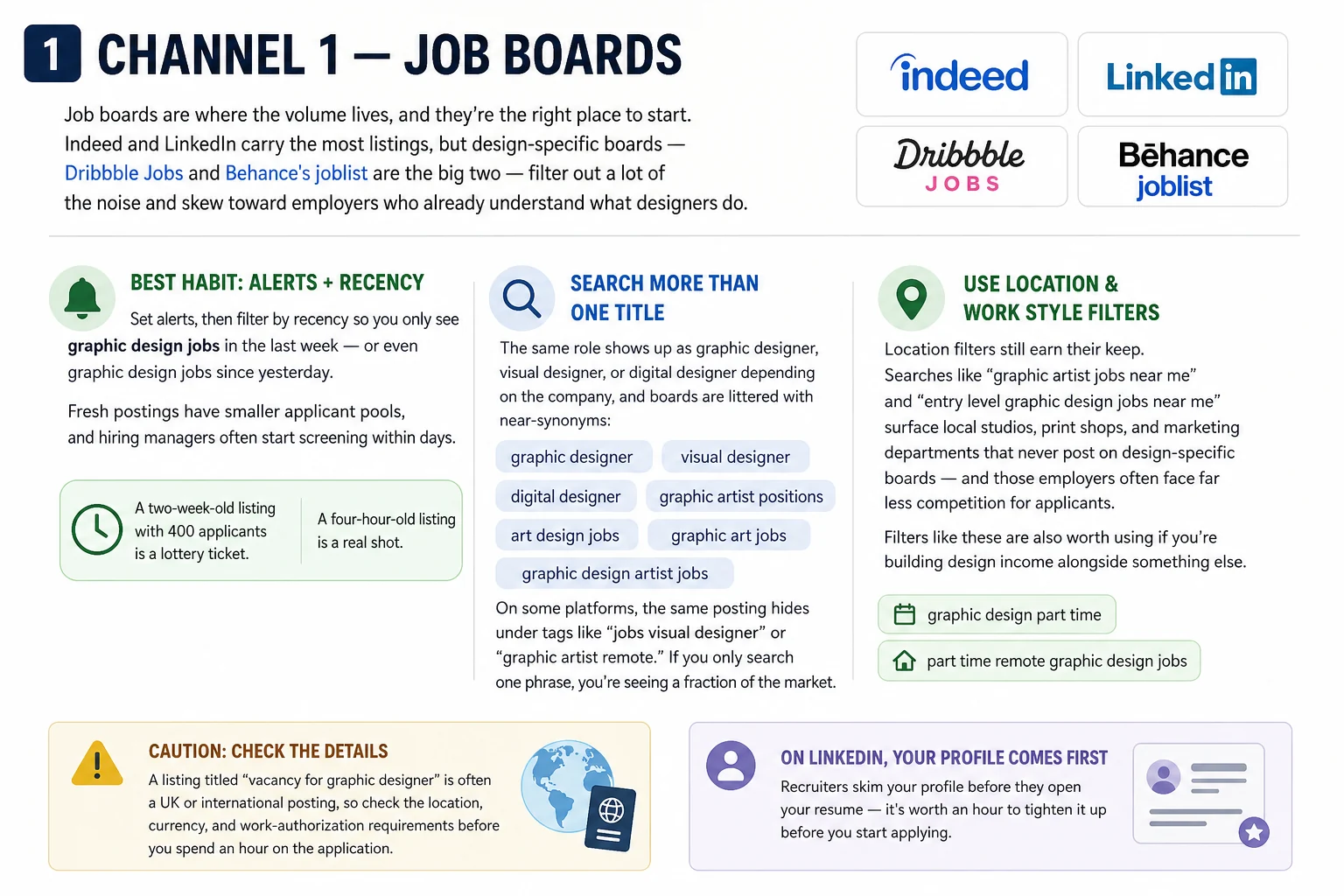 Job boards carry the most listings, but freshness matters more than volume — a four-hour-old posting is a real shot, a two-week-old one is a lottery ticket.
Job Boards
Job boards are where the volume lives, and they're the right place to start. Indeed and LinkedIn carry the most listings, but design-specific boards — Dribbble Jobs and Behance's joblist are the big two — filter out a lot of the noise and skew toward employers who already understand what designers do.
Fresh postings have smaller applicant pools. A two-week-old listing with 400 applicants is a lottery ticket. A four-hour-old listing is a real shot.
The same role shows up as graphic designer, visual designer, or digital designer. Boards are littered with near-synonyms: graphic artist positions, art design jobs, graphic art jobs. Search more than one phrase.
Searches like "graphic artist jobs near me" and "entry level graphic design jobs near me" surface local studios and print shops that never post on design-specific boards — and face far less competition.
Freelance Platforms
Upwork, Fiverr, and 99designs are the default freelance route, and a post reading "freelance graphic designer wanted, logo for a new coffee brand" is the typical phrasing you'll see thousands of times a day. Searches for "freelance graphic design jobs remote" lead here, and "online graphic jobs" is basically a synonym for this channel.
The Pricing Race to the Bottom Is Real
These platforms push pricing toward the bottom. Fiverr's race to the cheapest logo is infamous, and 99designs' contest model asks dozens of designers to work on spec while one gets paid. Clients who shop purely on price tend to be the hardest to work with, too.
So why bother? Because the first five to ten paid projects do something a portfolio of classwork can't: they prove you can take a brief, hit a deadline, and handle a client who changes their mind twice. Platform reviews become references. And once you've got that proof, you raise your rates and shift toward direct clients — which is where the decent freelance money actually lives. Our Freelancing 101 guide walks through that transition in more detail.
Use the platforms to bootstrap, in other words. Don't build a permanent home on their cheapest tier.
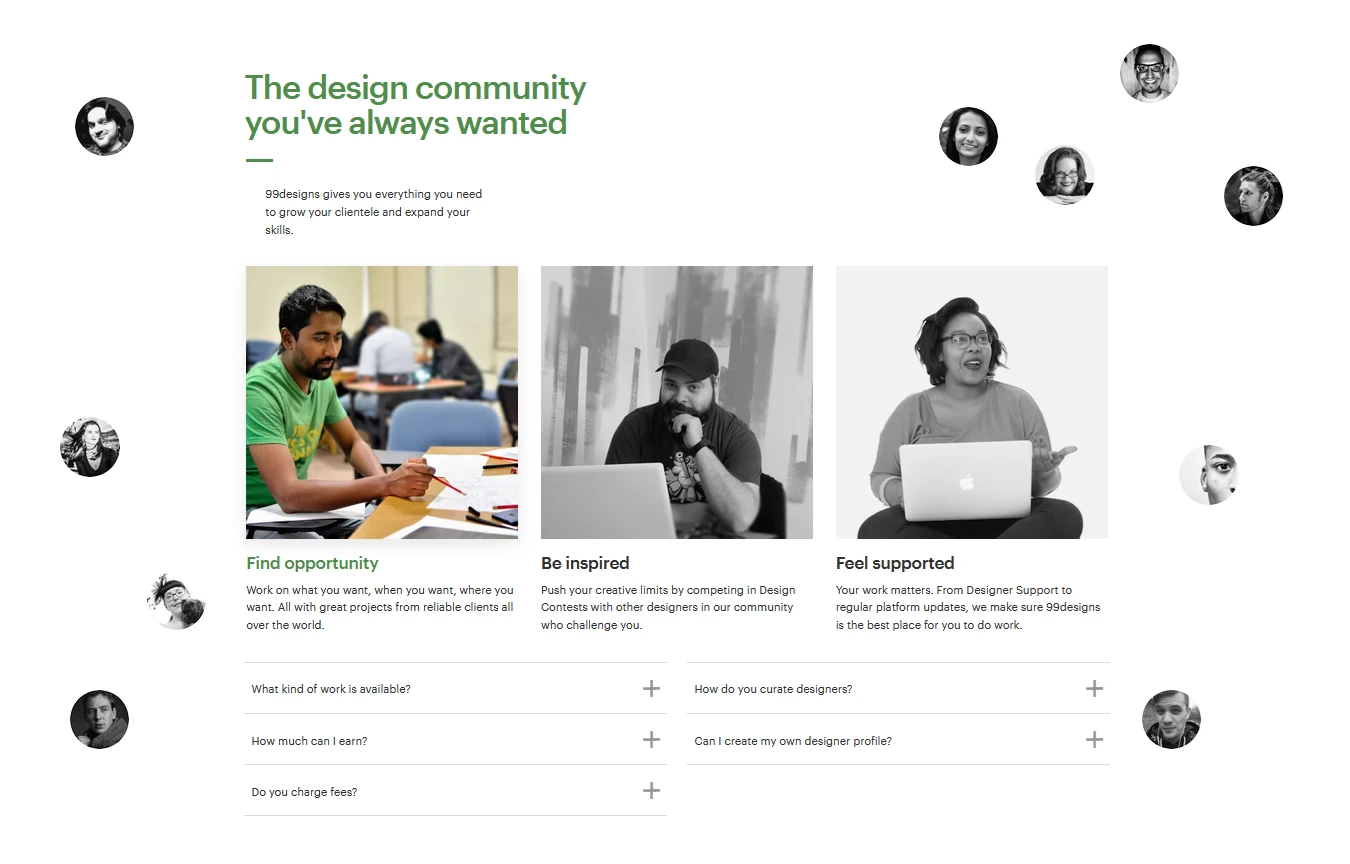 Platforms like 99designs are a solid bootstrap route — build proof of client delivery, then raise your rates and move to direct clients.
Keep Your Pipeline Organized
One practical note: once you're applying on boards and pitching platforms at the same time, tracking who you contacted, what you quoted, and when to follow up gets messy fast. We built the free Side Hustle Toolkit at Luck & Fortune Finance for exactly that situation — it keeps your applications, client follow-ups, and rates across platforms in one place, so nothing slips while you juggle channels.
Agencies and Staffing Firms
The channel designers overlook most is creative staffing agencies. Firms like Aquent, Creative Circle, and the creative arm of Robert Half place designers into contract and contract-to-hire roles, and they handle a big share of junior graphic designer positions that never reach the public boards. For steady graphic artist employment without a stacked resume, it's often the fastest door in.
What They Look For
A tight portfolio, fluency in the standard toolkit (Adobe Creative Cloud, Figma), and — this surprises people — reliability. Staffing firms make money when a placement works out, so they favor designers who answer emails, hit deadlines, and take feedback without drama.
The Tradeoffs
Staffing firms take a margin on your rate, and contract work usually means no benefits. In exchange, you get paid experience and client variety while other applicants are still refreshing Indeed. One good gig quietly becomes three.
You can also watch for graphic design agencies hiring directly. Agency posts are often written in shorthand — "hiring graphic designer, mid-level, hybrid" tells you the seniority and the location model in six words — and smaller agencies move faster than corporate HR departments.
CompensationWhat Graphic Design Work Pays
Here's what graphic design work typically pays in 2026, broken down by experience and arrangement:
The BLS anchors the middle of that table: a $61,300 median, with the lowest 10% of designers earning under $37,600 and the top 10% clearing $103,030 (May 2024 data). Two caveats matter. First, geography still moves salaries even for remote roles — a graphic designer position at a San Francisco startup and the same title at a Midwest manufacturer can differ by $20,000 or more. Second, specialization matters as much as seniority. Motion design, UI, and product work consistently outpay print and generalist design; the BLS pegs web and digital interface designers at a median of $98,090, roughly $37,000 above the graphic designer median. If you're early in your career, that's a strong hint about which skills compound.
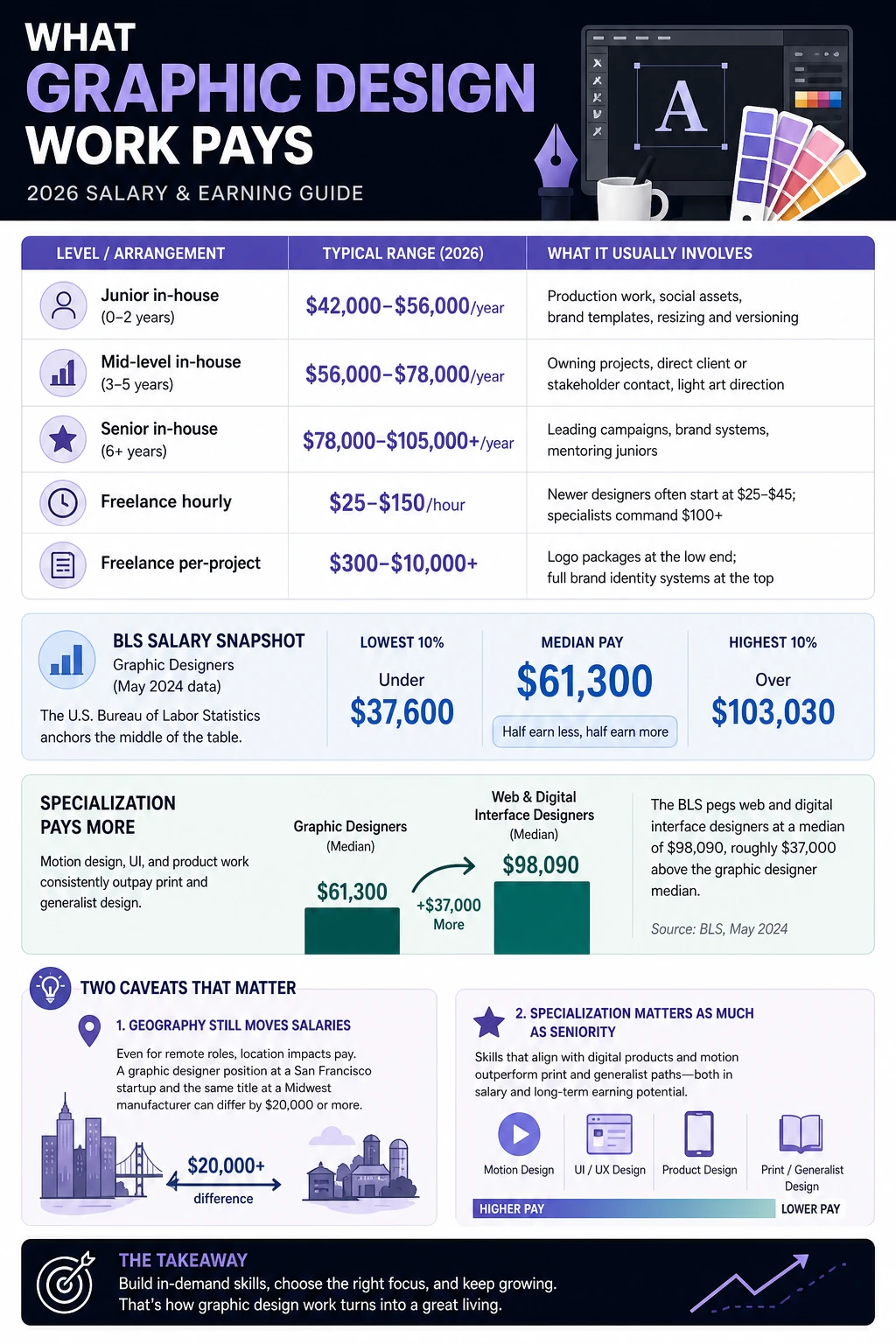 Pay ranges vary by experience, arrangement, and specialty — digital and UI roles consistently out-earn generalist and print positions.
Portfolio Beats Degree
So what does a hiring manager actually scan for in those first thirty seconds? Roughly four things:
Six to Ten Strong Projects
Not twenty. A tight selection signals judgment; a padded portfolio signals the opposite.
Case-Study Framing
For each piece: the problem, the constraints, your decisions, the result. One sentence of context turns a pretty image into evidence you can think.
Craft Consistency
Typography, spacing, and color judgment across every piece. One sloppy project drags down nine good ones.
Relevance to the Role
Lead with work that resembles the job you're applying for, not the work you enjoyed most.
It's telling that the BLS itself says candidates should have a portfolio demonstrating creativity and originality — the degree gets listed as typical education, but the portfolio is the differentiator. If your book is thin, two or three self-initiated projects (a rebrand for a local nonprofit, a spec redesign of a known app) beat a dozen weak class assignments.
Refuse Unpaid Spec Work Disguised as a Hiring Step
Some companies request a "quick test project" that turns out to be real deliverables — a redesigned landing page, a mocked-up campaign. AIGA, the professional association for design, has long discouraged spec work, and for good reason. A legitimate hiring process either keeps test exercises small and clearly scoped — an hour or two, a hypothetical brief, a defined deliverable — or pays for meaningful work. A company that wants free production work from applicants is telling you how it treats designers.
Your First 30 Days
Job searches fail in two ways: spraying identical applications everywhere, or tinkering with a portfolio forever and applying nowhere. This plan avoids both.
Cut your portfolio to its best six to ten pieces and write a one-line brief for each. Refresh your Dribbble and Behance pages, fix your LinkedIn headline, and set recency-filtered alerts on two or three boards. Register with one or two staffing agencies — intake calls take twenty minutes.
Send five to ten tailored applications to fresh postings, reordering your portfolio so the most relevant work leads for each one. Tailored means the cover note names their product and references a specific project of yours. Anything less reads like a form letter, because it is one.
If freelancing appeals, put profiles live on Upwork or Fiverr and send your first ten proposals at honest rates — not bottom-feeder rates. Then follow up on week two's applications; a short, polite nudge after five to seven business days is professional, not pushy.
Count responses by channel. If boards produced nothing but a staffing agency did, you know where to spend week five. Ask for feedback on rejections — you won't always get it, but the answers you do get are worth more than another tutorial. Refresh the portfolio with anything new.
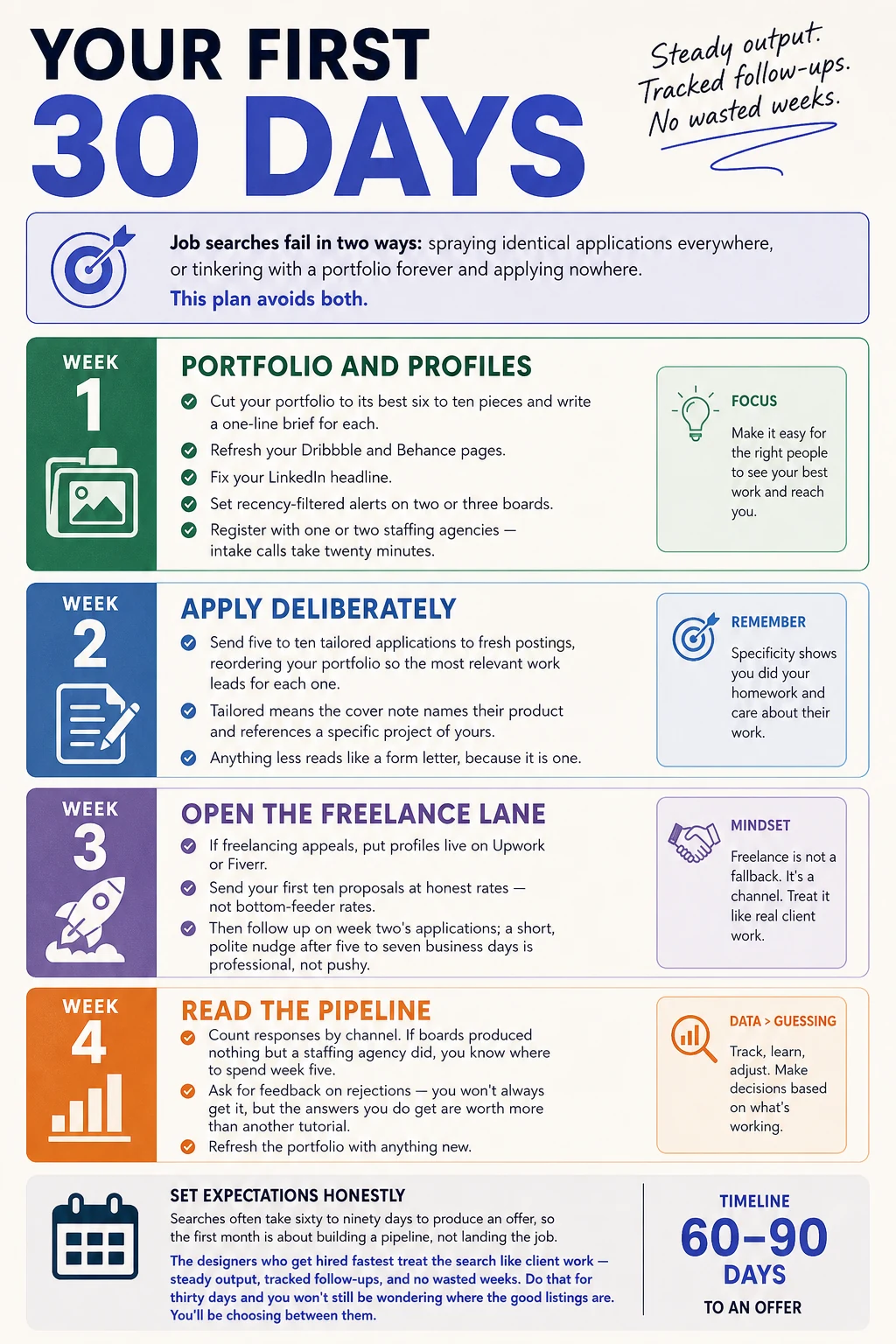 The first month is about building a pipeline, not landing the job. Designers who get hired fastest treat the search like client work.
Set Your Expectations Honestly
Searches often take sixty to ninety days to produce an offer, so the first month is about building a pipeline, not landing the job. The designers who get hired fastest treat the search like client work — steady output, tracked follow-ups, and no wasted weeks. Do that for thirty days and you won't still be wondering where the good listings are. You'll be choosing between them.
FAQ: Graphic Design Jobs
Graphic design jobs live on three channels: general job boards (volume, freshness rewards), design-specific platforms (Dribbble, Behance — less noise), and creative staffing agencies (Aquent, Creative Circle — the hidden pipeline for junior roles). The BLS median is $61,300, but digital specializations push toward $98,000+. Your portfolio is the differentiator, not your degree. Treat the search like client work: tailoring applications, tracking follow-ups, and building a pipeline that compounds over thirty days.

Track Every Income Stream in One Place
Organize your job applications, freelance invoices, and client follow-ups alongside your budget with our free Side Hustle Toolkit.
Get the Free Toolkit