
Social media manager jobs are one of the few online careers where you can start with zero formal experience, build a portfolio in weeks, and land paying clients before most people finish their first online course. The Bureau of Labor Statistics groups social media managers under public relations specialists — a category with a 2024 median salary of $69,780 and projected 5% job growth through 2034. That's the employed path. Freelance social media managers often earn more per hour once they've built a client base, with rates ranging from $25 to $175 depending on experience and scope.
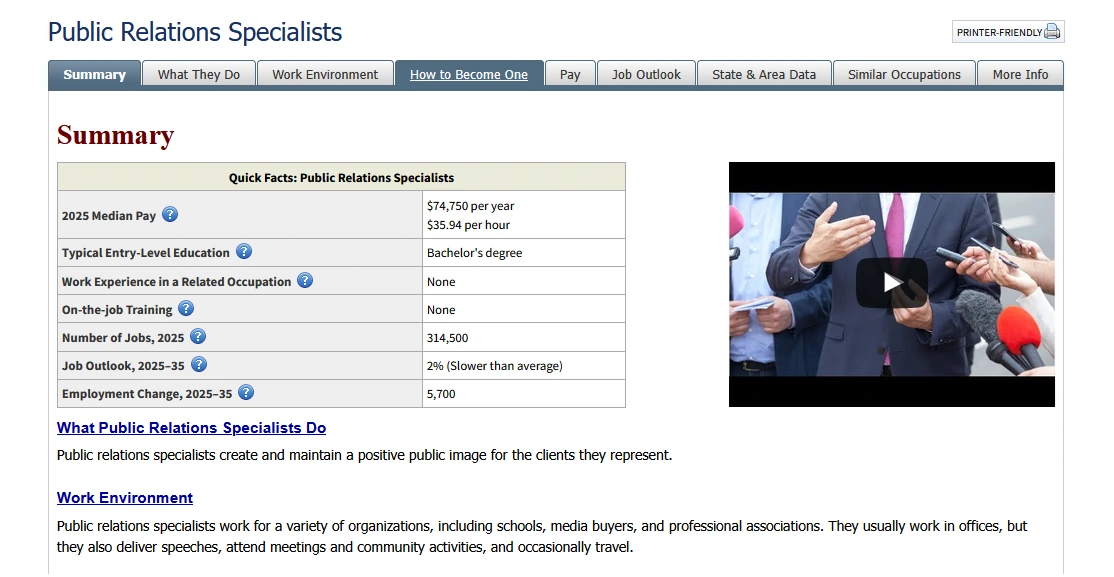 The BLS groups social media managers under public relations specialists, a category with a 2024 median salary of $69,780 and 5% projected job growth through 2034.
What Does a Social Media Manager Actually Do?
A social media manager handles a brand's presence across platforms like Instagram, TikTok, LinkedIn, Facebook, and X. That sounds broad, so let's get specific about what the work actually involves day to day.
Content Creation
You're writing captions, designing graphics (using tools like Canva or Adobe Express), filming short-form video, and scheduling posts. For most clients, you'll manage a content calendar — a spreadsheet or tool like Buffer or Later that maps out what goes live and when.
Community Management
Responding to comments, DMs, and mentions is the core of the role — you're the voice of the brand in conversations. Some clients expect you to handle customer complaints that surface on social, which means you need good judgment about when to escalate.
Analytics & Reporting
You'll pull numbers on reach, engagement, click-throughs, and follower growth — then explain what they mean to a client who may not live in the data. Monthly reports are standard.
Paid Social
Running Meta Ads, TikTok Ads, or LinkedIn campaigns is often an add-on service, not a requirement. Beginners rarely start here. But if you can learn ad management, it significantly increases your earning potential.
The scope varies by client. A local bakery might need three Instagram posts a week and some comment replies. A B2B SaaS company might want a full content strategy across LinkedIn, X, and YouTube with weekly video production. Understanding where you fall on that spectrum determines what you charge — and who you should be pitching.
How Much Do Social Media Managers Make?
This is the question everyone asks first, and the honest answer is: it depends on whether you're employed or freelancing, and how much experience you bring.
Employed Social Media Manager Salary
For full-time social media manager positions, here's what the market looks like in 2026:
| Experience Level | Annual Salary Range | What You'd Typically Do |
|---|---|---|
| Entry-level (0-2 years) | $35,000-$50,000 | Execute someone else's strategy, schedule posts, pull basic analytics |
| Mid-level (3-5 years) | $58,000-$74,000 | Own the content calendar, manage 2-3 platforms, create original content |
| Senior (5+ years) | $75,000-$110,000+ | Lead social strategy, manage teams, oversee paid campaigns and cross-channel integration |
The BLS median for the broader PR specialist category sits at $69,780, which lands squarely in the mid-level range. Remote social media manager roles tend to pay at the higher end of these bands — Sprout Social's 2026 data estimates average remote salaries around $90,000 for experienced hires.
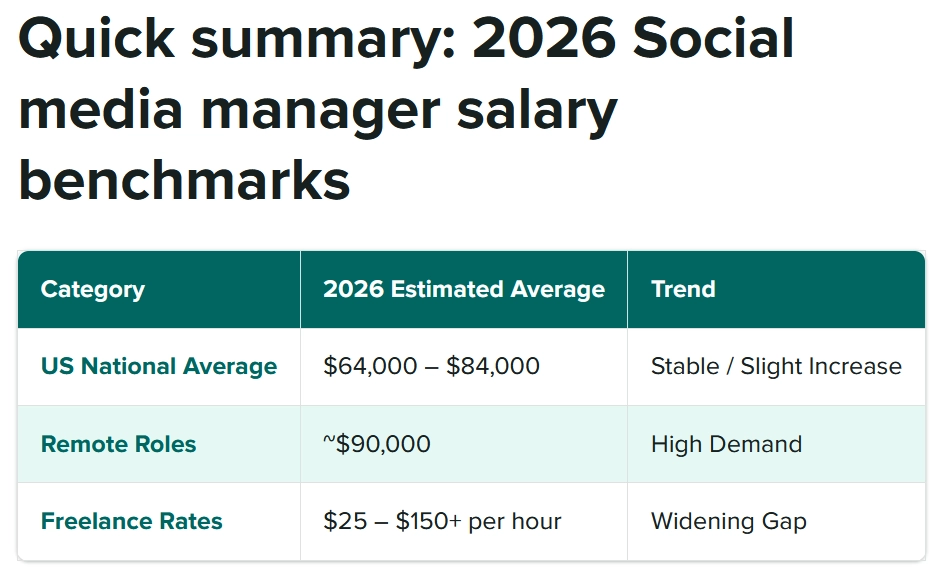 Experienced remote hires can command around $90,000 per year, according to Sprout Social's 2026 salary data.
Freelance Social Media Manager Rates
Freelancing changes the math entirely. Instead of a fixed salary, you're billing per client — and the range is wide:
| Experience Level | Hourly Rate | Monthly Retainer Per Client |
|---|---|---|
| Beginner (0-2 years) | $20-$45/hr | $500-$1,500/mo |
| Intermediate (2-5 years) | $45-$85/hr | $1,500-$3,500/mo |
| Expert (5+ years) | $85-$175/hr | $3,500-$7,000+/mo |
A freelancer with three clients paying $1,500/month each earns $54,000/year — competitive with an entry-level salary but with the flexibility to scale. The median freelance retainer in 2026 sits around $2,850 per client for a standard scope of 15-30 posts, community management, and a monthly report.
The catch? Freelancers don't get benefits, paid time off, or employer contributions to taxes. When you're calculating your rate, factor in self-employment tax (15.3%), health insurance, and the cost of tools. A $50/hr rate effectively becomes $38-$42 after those costs. That's still solid — but it's not the same as a $50/hr salary.
Freelance vs. Employment: Which Path Is Right for You?
Neither path is universally better. Here's how they actually compare:
Freelancing Wins When You Want
- Flexibility to choose your clients and hours
- Higher earning potential once established (top freelancers exceed $150K/year)
- No commute, no office politics
- The ability to work with multiple industries simultaneously
Employment Wins When You Want
- Predictable income and benefits (health insurance, 401k, PTO)
- Structured learning from experienced colleagues
- Less risk — you don't have to find clients or chase invoices
- A clearer career ladder within an organization
The middle ground: Many social media managers start as freelancers to build experience, then transition to full-time roles — or vice versa. Some keep a part-time employed role while taking on one or two freelance clients on the side. If you're exploring flexible work arrangements, our freelancing 101 guide covers the fundamentals of going independent.
The hybrid approach works well for beginners. You can take on a few social media remote jobs through platforms like Upwork while building the skills and portfolio needed to land a higher-paying full-time social media manager position. For those specifically looking for social media supervisor jobs, many companies post these roles on LinkedIn and Indeed — they typically require 3-5 years of experience but offer solid salaries in the $60K-$80K range.
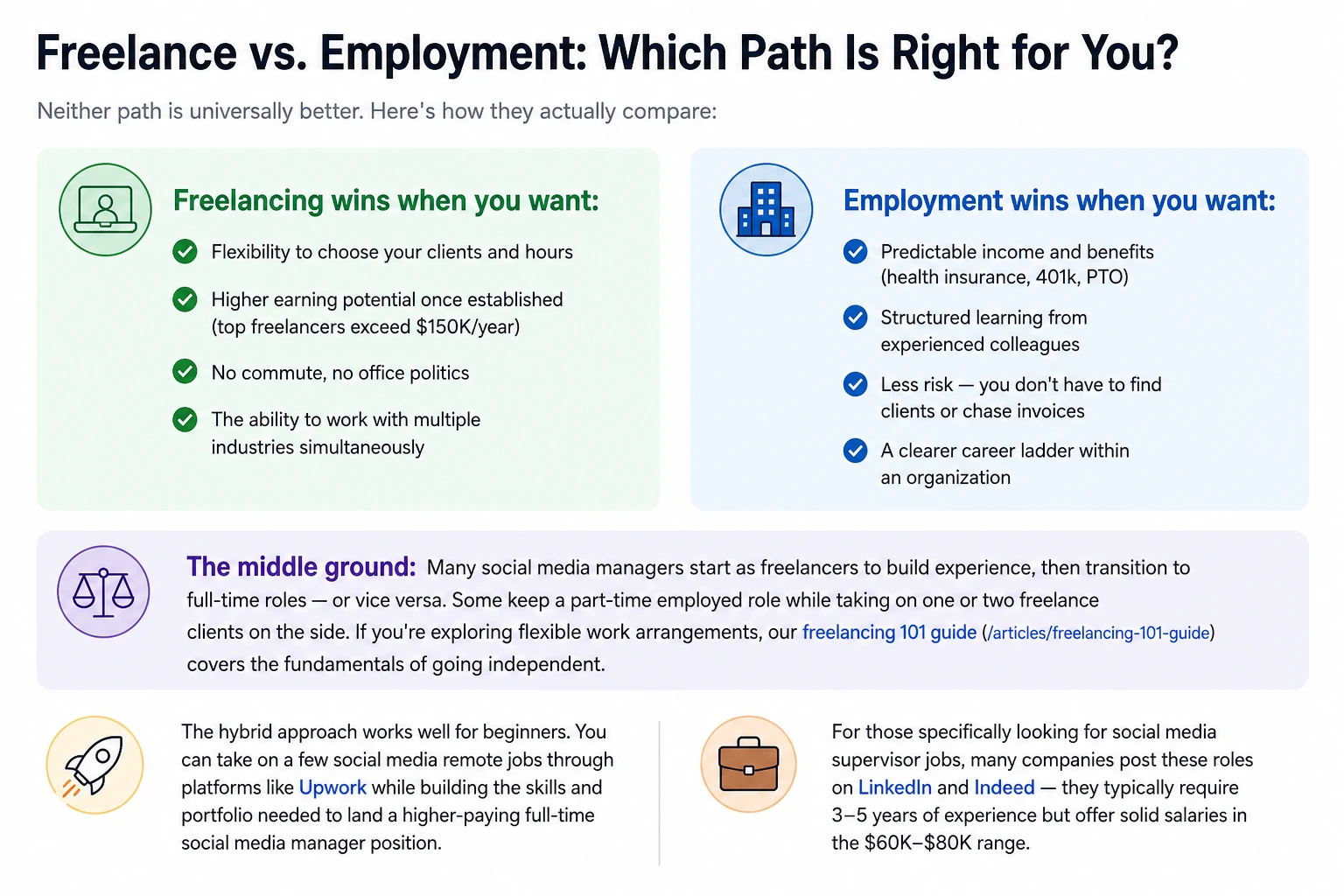 Freelancing offers flexibility and higher upside; employment offers stability and benefits. Many social media managers blend both paths.
Where to Find Social Media Manager Jobs
Knowing where to look matters as much as knowing what to charge. Here's a breakdown of the platforms that actually deliver results:
Freelance Platforms
Upwork
The largest freelance marketplace, and social media management is one of its most in-demand categories. Rates range from $14-$55/hr, though platform fees (10% for freelancers) eat into earnings. Browse social media jobs on Upwork.
Fiverr
Better for project-based work than ongoing retainers. You set a fixed price for specific deliverables, like 12 Instagram posts for $300. The 20% freelancer fee is steep, so price accordingly. Start selling on Fiverr.
PeoplePerHour
Popular in the UK and Europe but with a growing US presence. A good place to find part time social media jobs with small businesses and solo founders. Browse freelance social media jobs on PeoplePerHour.
Job Boards
- LinkedIn — Search for "social media manager jobs remote" or "social media specialist jobs." LinkedIn also shows salary ranges on many listings, which helps you benchmark before applying. Many social media manager positions are posted here exclusively.
- Indeed — Aggregates listings from company career pages and recruiters. Filter by "remote" and "part-time" to narrow results.
- Glassdoor — Useful for salary research and reading employee reviews of companies before you apply.
Direct Outreach
The highest-paying clients rarely post on job boards. Instead, they hire through referrals or respond to cold outreach. Here's what works:
- Identify 10-15 local businesses with weak or inactive social media.
- Audit their accounts — note what's missing (consistent posting, engagement, video content).
- Send a short email or DM offering a free 30-day content plan.
- If they like the plan, pitch a paid engagement.
This approach takes more effort upfront, but the payoff is significant. Freelancers who land clients through direct outreach typically charge 30-50% more than marketplace rates because there's no platform fee and the client relationship starts with trust.
Niche Job Boards
- We Work Remotely — Remote-first job board with a dedicated marketing category
- FlexJobs — Curated remote and flexible jobs (paid subscription required)
- MarketingHire — Focused specifically on marketing roles, including social media
Looking for More Remote Work Options?
Check our virtual assistant jobs guide — many VA roles overlap with social media management duties, and the skills transfer directly.
Social Media Manager Careers: Long-Term Paths
If you're thinking about social media manager careers beyond freelance work, the employed path offers clear progression. Social media manager hiring has accelerated as companies recognize the ROI of dedicated social teams. Entry-level social media manager positions typically start at $35K-$50K, but experienced social media managers with proven track records can command $75K-$110K+ in senior roles. Social media specialist jobs are a common stepping stone — they focus on execution rather than strategy, making them ideal for building skills before moving into management.
How to Build a Portfolio With No Experience
This is the biggest barrier for newcomers, and it's more solvable than most people think. You don't need a client to build a portfolio — you need proof you can do the work.
Start With Your Own Accounts
Run your personal social media like a business. Post consistently, experiment with content types, track your engagement numbers, and document what works. A personal Instagram or TikTok with 200 followers and a clear content strategy is more impressive than a barren profile with 5,000 dormant followers.
Create Mock Client Projects
Pick three brands you admire — a local coffee shop, a startup, a nonprofit — and create a full content package for each:
- A one-month content calendar with post copy and visual concepts
- A brand voice guide (one page explaining tone, vocabulary, and posting style)
- A sample analytics report showing what you'd track and how you'd present results
These don't need to be real clients. The point is demonstrating that you understand the workflow from strategy to execution.
Offer Free or Discounted Work (Strategically)
Don't do free work for everyone. Pick one or two businesses where you can create a genuine case study. Run their social media for 30 days, document the results (follower growth, engagement rate changes, content performance), and use that as your first portfolio piece.
The key is setting a clear end date. "I'll manage your Instagram for 30 days at no cost" is a trial. "I'll do your social media for free" is exploitation. Frame it as a limited engagement, deliver exceptional work, and you'll have a paying client or a compelling case study — often both.
Use Portfolio Platforms
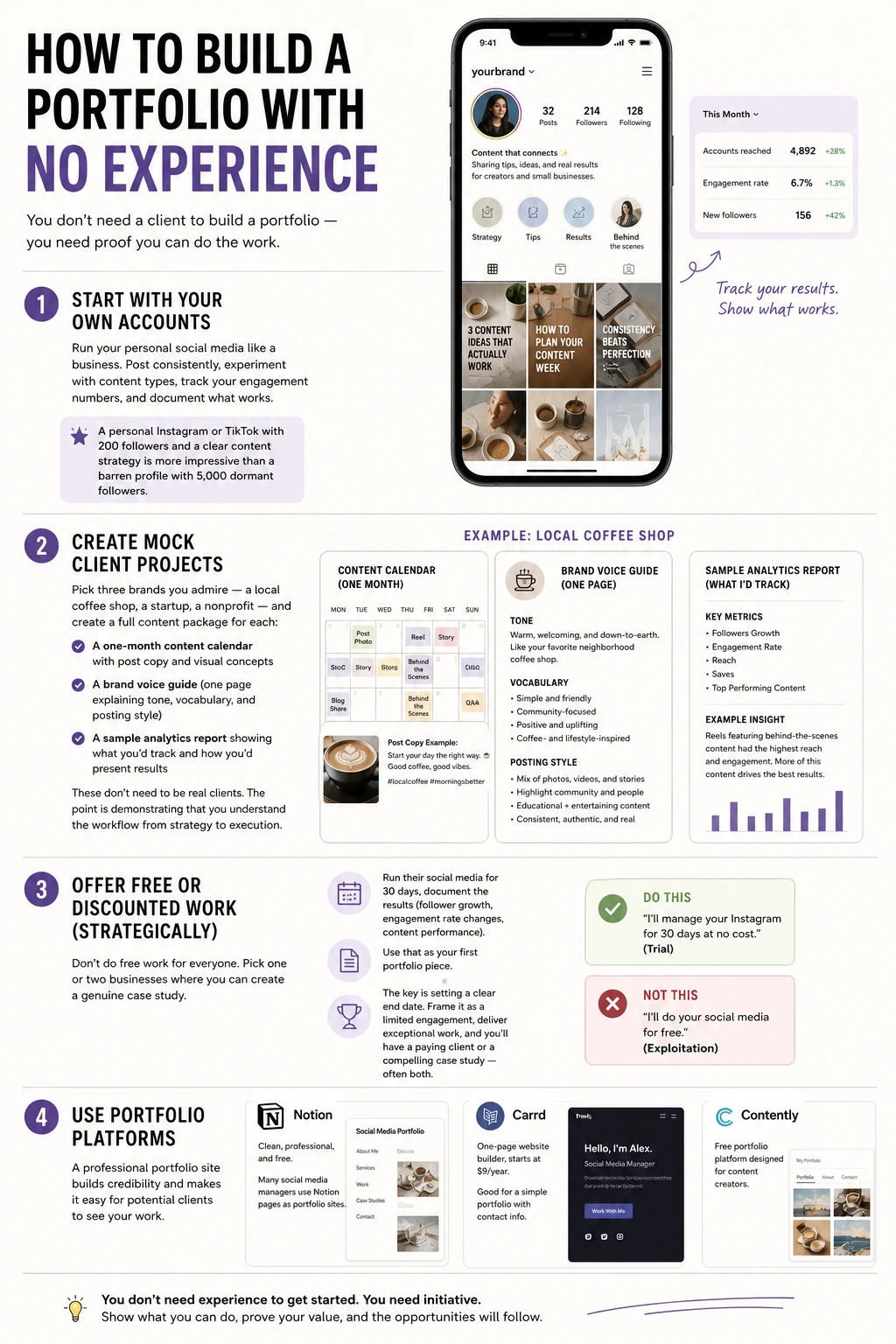 You don't need paying clients to build a portfolio — mock projects and documented results can prove you can do the work.
What to Charge: Pricing Strategies for Beginners
Pricing is where most new social media managers freeze. Charge too little and you undervalue your work. Charge too much and you can't land clients. Here's a practical framework:
For your first one or two clients, charge $500-$800/month for a basic scope: one platform, 8-12 posts per month, and community management. This gets you in the door without pricing yourself out.
Once you have three paying clients and a portfolio showing results, move to $1,000-$1,500/month. At this point, you should be offering multi-platform management and basic content creation.
A one-time setup fee of $300-$800 covers the brand audit, content calendar build-out, and initial strategy work. This is standard practice and protects you from doing weeks of unpaid onboarding.
Hourly billing creates a conflict: the client wants fewer hours, you want more. Retainers fix this by locking in scope, deliverables, and payment. Use hourly rates only for one-off projects like audits or ad creative.
For a deeper breakdown of freelance pricing mechanics, our part-time jobs guide covers how to structure rates across different side hustles.
Skills You Actually Need (and What You Can Learn on the Job)
You don't need a marketing degree. Here's what actually matters:
Must-Have Skills
- Writing clear, engaging copy (captions, headlines, CTAs)
- Basic graphic design (Canva proficiency gets you 80% of the way there)
- Understanding of platform algorithms and best practices
- Analytics literacy — you need to read engagement data and explain it to clients
- Time management — juggling multiple clients requires systems
Nice-to-Have Skills That Increase Your Rate
- Short-form video production (CapCut, InShot, or native platform editors)
- Paid social advertising (Meta Ads Manager, TikTok Ads)
- Email marketing integration
- Basic SEO knowledge for LinkedIn and YouTube content
Skills You Can Learn on the Job
- Industry-specific knowledge (you'll learn a client's niche quickly)
- Advanced analytics tools (Sprout Social, Hootsuite Insights)
- Community management at scale
The barrier to entry is lower than most people expect. If you can write a compelling Instagram caption and design a basic graphic in Canva, you have enough to start pitching clients. Everything else improves with practice.
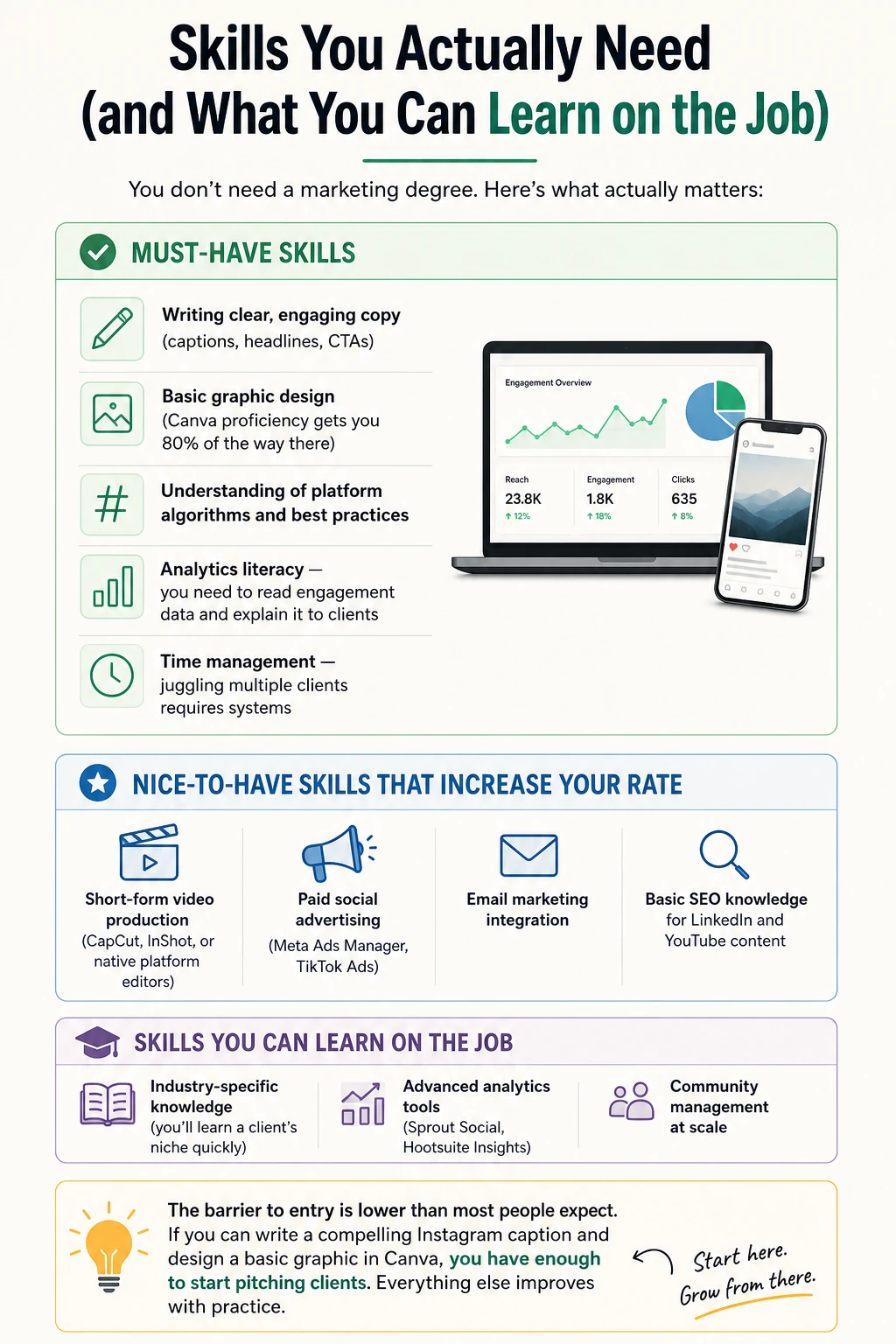 Writing, basic design, and analytics literacy matter more than a marketing degree. Everything else improves with practice.
Common Mistakes to Avoid
We've seen these patterns sink new social media managers more than anything else:
Undercharging to "Get Experience"
There's a difference between a strategic discount and desperate pricing. $200/month for full social media management isn't a foot in the door — it's a signal that your work isn't worth paying for. Set a floor and stick to it.
Saying Yes to Every Client
Not every client is a good fit. A client who expects 24/7 availability, refuses to approve content calendars, or wants you to "just go viral" will drain your time and energy. Screen clients before committing.
Skipping the Contract
Always use a written agreement that outlines scope, payment terms, revision limits, and ownership of content. Without one, you're one misunderstanding away from working for free.
Ignoring Analytics
Posting without tracking results is like driving with your eyes closed. Pull numbers monthly, show clients what's working, and use data to justify rate increases.
Trying to Be on Every Platform
You don't need to master every social channel. Pick two or three platforms, become excellent at those, and expand from there. Clients hire specialists, not generalists who spread themselves thin.
Getting Started This Week
If you're ready to pursue social media manager jobs, here's your 30-day action plan:
Audit your own social media. Set up a content calendar for your personal accounts. Create a free portfolio page on Notion or Carrd.
Build three mock client projects. Research 10 local businesses with weak social media. Draft your outreach email template.
Send your first five outreach messages. Apply to three Upwork or Fiverr gigs. Set up profiles on LinkedIn and Indeed with "social media manager" in your headline.
Follow up on outreach. Deliver your first mock project. Adjust your rates based on response patterns. Pitch a 30-day trial to your warmest lead.
The demand for social media manager positions is real and growing. The BLS projects 5% job growth through 2034, and businesses of every size need someone who can manage their online presence effectively. Social media manager hiring is accelerating across industries — from local restaurants to Fortune 500 companies. Whether you go freelance, take a full-time role, or build a hybrid career, the path is there — you just have to start walking it.
For more ways to earn on your own schedule, check out our guide to part-time jobs and side hustles that pay weekly.
Social media manager jobs are one of the fastest paths to online income: entry-level employed roles pay $35K-$50K, freelancers can start at $500-$1,500 per month per client, and the BLS projects 5% job growth through 2034. Build a portfolio with mock projects, set a pricing floor, and pitch 10-15 local businesses to land your first client within 30 days.
FAQ: Social Media Manager Jobs
Related Resources

Track Your Social Media Income
Organize your client retainers, freelance invoices, and other side hustle income alongside your budget with our free Side Hustle Toolkit.
Get the Free Toolkit