That box of old wires in your garage. The broken microwave you kept meaning to fix. The aluminum rims sitting behind the shed.
Most of us have junk accumulating somewhere, and at some point we wonder: Is this crap actually worth anything?
The short answer is yes—but not in the way social media videos suggest. Scrapping won't fund your retirement, and it's not passive income. Not even close. What it can do is turn clutter into a few hundred dollars if you know which items to scrap for money, where to take them, and how to avoid getting lowballed. At Luck & Fortune Finance, we investigated current scrap markets, real pricing data, and the legal pitfalls so you don't have to learn the hard way.
How Scrapping Actually Works
Before you load your trunk with random metal, it helps to understand how scrap yards operate. They aren't flea markets—they're commodity buyers.
Ferrous vs. Non-Ferrous
Scrap yards split metals into two broad categories. Ferrous metals contain iron and attract a magnet. Think steel car parts, old appliances, and cast iron. They're common but low value per pound. Non-ferrous metals—copper, aluminum, brass, lead, stainless steel—don't contain iron. They command significantly higher prices because they resist corrosion and are harder to mine.
"Clean" vs. "Dirty" Metal
"Clean" metal is pure and uncontaminated. Bare copper wire is clean; insulated copper wire is "dirty" because the plastic coating adds weight without value. Clean metal pays more per pound because the yard doesn't have to process it. Stripping insulation, removing screws, and separating alloys directly increases your payout.
How Prices Are Set
Scrap prices track global commodity markets. A yard in Ohio pays roughly the same baseline as a yard in Texas, minus regional transport costs and local demand. Prices update daily or weekly, which is why the same pile of brass might fetch $40 one month and $55 the next. Most yards publish their current rates, and apps like iScrap App aggregate user-reported prices nationwide.
Best Items to Scrap for Money
If you're clearing out a basement, garage, or recently inherited property, these are the items to prioritize. Prices below reflect national averages as of late June 2026, sourced from iScrap App's live price listings. Regional variation is normal—call your local yard before making the trip.
| Item | Type | Approximate Price (June 2026) | Source |
|---|---|---|---|
| Bare bright copper wire | Non-ferrous | ~$4.55/lb | iScrap App |
| #1 copper tubing | Non-ferrous | ~$4.19/lb | iScrap App |
| Yellow brass | Non-ferrous | ~$2.18/lb | iScrap App |
| Insulated copper wire | Non-ferrous | ~$1.18/lb | iScrap App |
| Aluminum cans | Non-ferrous | ~$0.65/lb | iScrap App |
| Sheet aluminum | Non-ferrous | ~$0.60/lb | iScrap App |
| Cast aluminum | Non-ferrous | ~$0.51/lb | iScrap App |
| Aluminum rims | Non-ferrous | ~$0.68–$0.85/lb | iScrap App |
| Lead batteries | Non-ferrous | ~$0.18/lb | iScrap App |
| Electric motors (copper) | Mixed | ~$0.25–$0.30/lb | iScrap App |
| Shreddable steel / light iron | Ferrous | ~$165–$168/ton | iScrap App |
Copper and brass are your heavy hitters. A five-gallon bucket of bare copper wire can easily clear $80–$120. Aluminum is lighter per dollar, but it's everywhere—cans, siding, old ladders, boat parts. Steel pays the least per pound, yet a full washer or dryer can still net $15–$30 simply because of the weight.
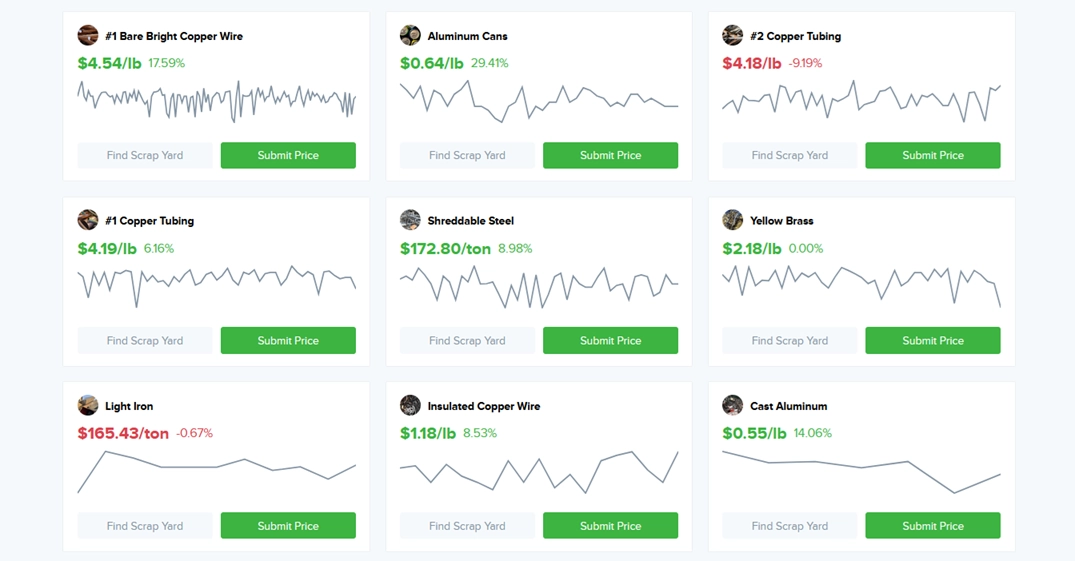 iScrap App aggregates user-reported scrap prices nationwide—check your local yard before hauling a heavy load.
Most Profitable Items (High-Value Targets)
If you want the most money for scrap metal, look past the obvious and target these specific items.
Catalytic Converters
Catalytic converters contain platinum, palladium, and rhodium, making them one of the single most valuable pieces on a vehicle. Typical scrap values range from roughly $50 to over $1,200 per unit, depending on the vehicle and the day's precious metal markets.
Critical legal caveat: Converter theft has triggered strict laws across the United States. An increasing number of states now require government-issued photo ID, proof of ownership, and transaction reporting to state databases when selling a detached converter. Some states impose holding periods before the buyer can process the unit. Never sell a converter you can't prove you legally own. If you're scrapping an entire car you own, the cleanest path is selling the vehicle intact to a licensed yard and letting them handle the converter legally.
Copper Plumbing and Pipe
Old houses undergoing renovation often have copper pipe and fittings that plumbers discard. #1 copper tubing currently runs around $4.19/lb, and even #2/3 mixed copper sits near $3.93/lb. If you have access to legitimate construction scrap, this is among the best items to scrap for cash.
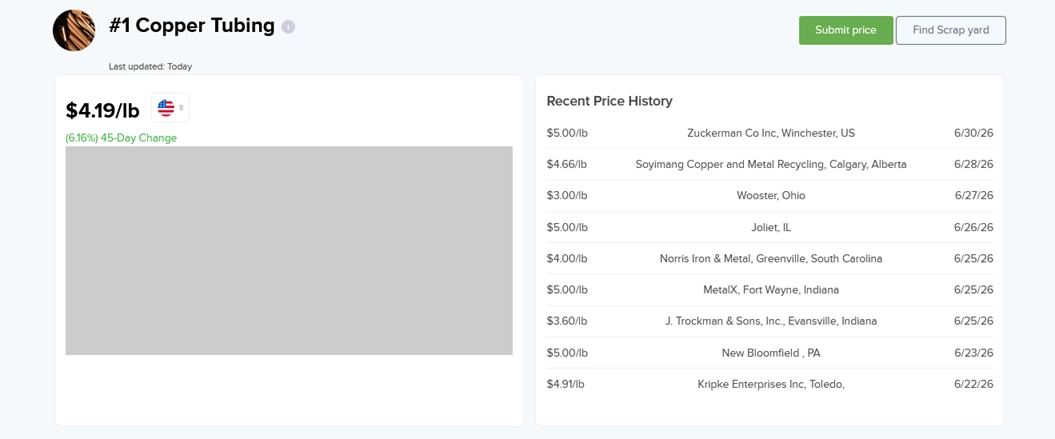 #1 copper tubing consistently leads scrap price charts—construction and renovation scrap is prime material.
Electric Motors
Microwaves, treadmills, power tools, and washing machines all contain electric motors with copper windings. While the per-pound rate is modest—roughly $0.25–$0.30/lb—motors are dense. A large treadmill motor can weigh 20+ pounds, and smaller motors add up fast if you're stripping multiple appliances.
PC Components
Computer scrap is a unique category because the money often comes from resale, not traditional smelting. Circuit boards, CPUs, and RAM sticks contain gold and other recoverable metals, but their real value currently sits in reuse. We'll cover this in detail in the next section.
Car Batteries
Lead-acid batteries are recyclable and steady sellers. Most auto parts stores and scrap yards accept them, with prices around $0.18/lb. A standard car battery weighs 30–50 pounds, so expect roughly $5–$9 per battery. It's not retirement money, but it's better than letting them corrode in your garage.
Money for Computer Scrap — Why RAM Is Suddenly Gold
Here's where scrapping gets interesting in 2026. If you have old computer parts sitting in a closet, do not toss them in the general scrap pile. The AI data center boom has created a severe memory shortage, and DDR5 RAM prices have surged to levels that make resale far more profitable than smelting.
According to Tom's Hardware, 32GB DDR5 kits now cost $375 minimum at retail—if you can find stock. Manufacturers have redirected production capacity toward enterprise and AI customers, squeezing consumer supply and inflating secondary market prices. PCPartPicker's live price trends show the spike clearly across nearly every DDR5 configuration.
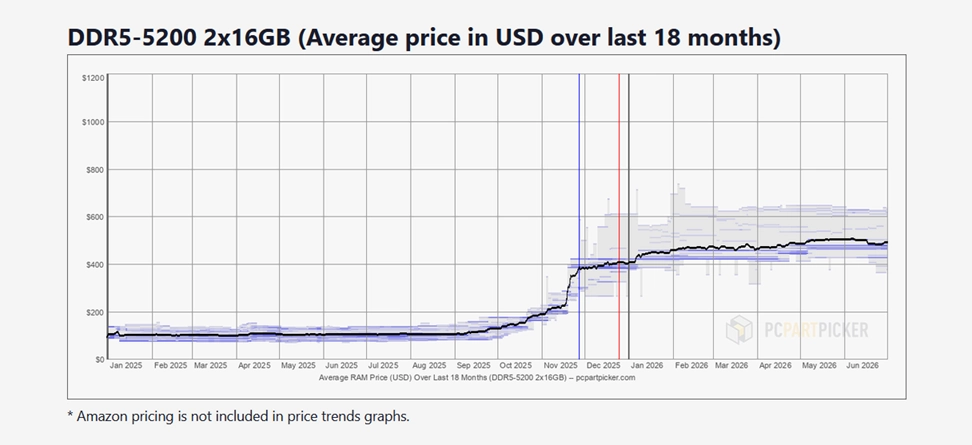 PCPartPicker's 18-month trend line shows how DDR5 memory prices spiked as AI data centers absorbed manufacturing capacity.
Personal experience: I personally just sold a pair of Crucial 16GB DDR5 5600MHz CT16G56C46S5 modules—32GB total—from an older computer of mine for $250. Made nearly one-third of what I paid for the PC itself. That same kit might have fetched $90 a year ago.
For computer parts, traditional scrap yards are rarely your best route. They're set up for bulk metal, not electronics resale. Instead, list components on OfferUp or eBay, where buyers building or upgrading PCs pay market rates for working RAM, CPUs, and GPUs. Even non-working circuit boards can sell to e-waste refiners on eBay who extract precious metals at scale.
If you have DDR4 or DDR5 memory from an old build, check recent sold listings before you do anything else. The AI-driven memory crunch may have turned your dusty RAM into the most profitable item in your house.
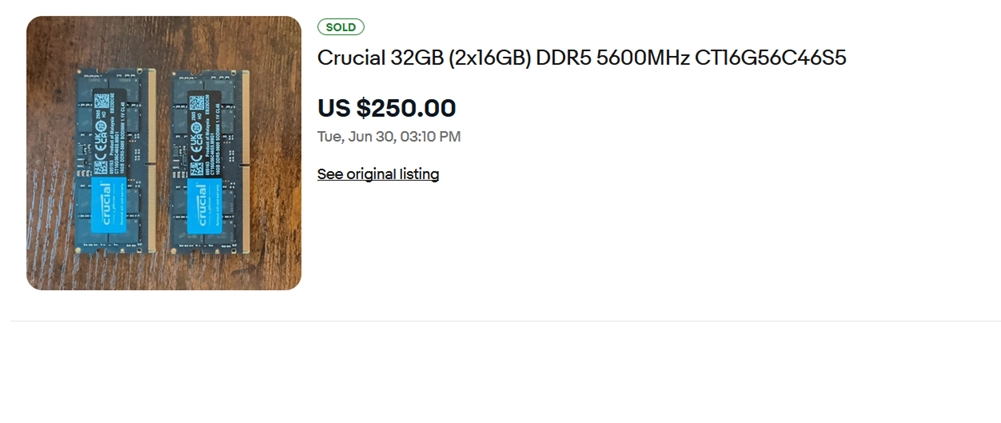 eBay sold listings confirm the secondary market premium—working DDR5 kits are fetching $200+ from buyers upgrading existing builds.
Where Can I Take Scrap Metal for Money?
You have three main options for turning scrap into cash.
Scrap yards and metal recycling centers are the standard destination. They buy by weight, pay same-day, and accept nearly everything on this list. Use the iScrap App directory to find licensed yards near you with user-reported prices.
Junkyards and auto salvage yards specialize in vehicles but also accept bulk metal and appliances. If you're scrapping a car—which we'll address shortly—these are your buyers.
Specialty buyers handle the categories general yards won't touch. Catalytic converter refiners, e-waste recyclers, and battery distributors often pay better for their specific niches because they're equipped to extract maximum value.
Regional variation is real. Shredded steel runs about $150–$260 per ton depending on your state, and copper can swing $0.50/lb or more between cities. Before you haul a heavy load, call two or three yards and ask:
- "What are you paying for #1 copper today?"
- "Do you buy electric motors whole, or do I need to strip them?"
- "Is there a minimum weight for steel drop-offs?"
Pro tip: Separate your metals before you arrive. Mixed bins get priced at the lowest-grade metal in the pile. Fifteen minutes of sorting can double your payout.
How Much Can You Get to Scrap a Car? (A Strong Warning)
This section exists to talk you out of scrapping your car if you have literally any other option.
A typical vehicle is worth $150 to $500 in raw scrap metal, based almost entirely on its weight multiplied by the current shredded-steel rate. Even with the catalytic converter and some reusable parts included, most complete cars bring $250 to $750 from a licensed buyer. Larger trucks or SUVs might stretch toward $1,000, but that's the top end for complete, running vehicles.
Here's the problem: even a rusty, high-mileage, unloved beater usually sells for $1,000+ on Craigslist or OfferUp if it still runs. A non-running car with a clean title and intact parts often brings $500–$800 from private buyers who want the engine, transmission, or body panels. The gap between scrap value and private-sale value is massive, and scrapping obliterates it.
Our position at Luck & Fortune Finance: car scrapping is for people in absolutely desperate situations—total title loss, catastrophic flood damage, or a vehicle stripped to the frame.
If the car still has wheels, glass, or an engine block, you will almost always net more by selling it whole. Private buyers and parts resellers pay closer to actual value. Scrap yards need to profit, which means they pay you far less than the aggregate value of what's sitting on their scale.
If your car doesn't run, list it as a "mechanic's special" or "parts car" before you call the junkyard. The difference between scrap payout and private sale payout is often the difference between a rent payment and a tank of gas.
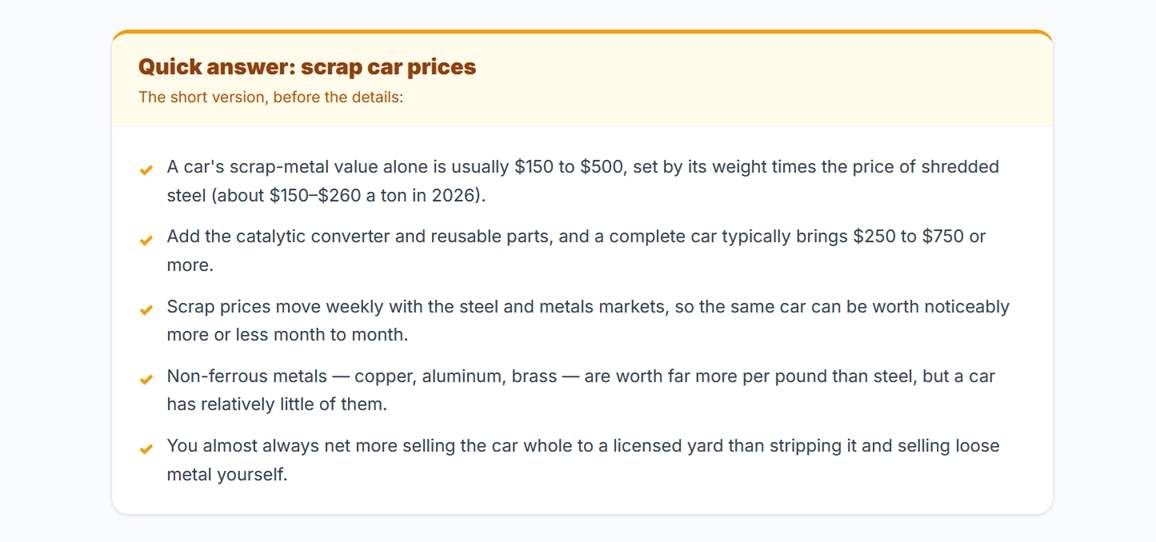 uPull-it's pricing confirms what most scrappers learn too late: even complete cars rarely break $750 at a licensed yard.
Quick Tips to Maximize Payout
Small habits separate the scrappers who make beer money from the ones who make bill money.
Strip for better rates. Bare copper wire pays roughly four times what insulated wire pays. Spend an hour with a wire stripper and watch your per-pound rate jump from ~$1.18/lb to ~$4.55/lb.
Separate ferrous from non-ferrous. A magnet is your best friend. If it sticks, it's steel or iron and goes in the low-value pile. If it doesn't stick, treat it carefully—it could be copper, brass, or aluminum.
Clean your metal. Remove solder, paint, screws, rubber, and plastic wherever practical. Clean brass pays more than dirty brass. Clean aluminum siding pays more than aluminum covered in caulk.
Hoard until prices are favorable. Commodity markets fluctuate. If copper just dropped $0.30/lb in a seasonal correction—and you don't need cash immediately—hold your stash. Prices often recover in the fall as construction demand picks back up.
Watch for safety hazards. Wear gloves and eye protection. Old appliances can contain capacitors that hold a charge. Lead batteries leak acid. Aluminum edges slice skin. Treat scrap like a job site, not a garage cleanup.
Bottom Line
Best items to scrap for money: Copper, brass, aluminum, and—right now, thanks to the AI shortage—computer RAM sold through resale markets rather than traditional yards. You can clear clutter, keep material out of landfills, and walk away with $50 to $300 on a good haul.
Scrapping is real income, but it's labor-intensive, commodity-dependent, and geographically variable. The best items to scrap for money are copper, brass, aluminum, and—right now, thanks to the AI shortage—computer RAM sold through resale markets rather than traditional yards. You can clear clutter, keep material out of landfills, and walk away with $50 to $300 on a good haul.
What you shouldn't do is treat scrapping like a side hustle replacement. It's not. It's a legitimate way to monetize stuff you already have, not a strategy for ongoing income. For that, you'd need a steady supply of free scrap, which most people don't have.
If you're stacking scrapping earnings alongside survey sites, testing gigs, or freelance work, consider using a tool like our Side Hustle Toolkit to track where the money's coming from and whether the hourly rate is worth your time. Not every pile of metal is worth the trip—but when you know what's actually valuable, you'll never look at your junk drawer the same way again.
Frequently Asked Questions
Yes, but with realistic expectations. Scrapping is not passive income and won't fund a retirement. A typical haul of copper wire, aluminum cans, and old appliances can net $50 to $300 depending on weight, metal type, and current commodity prices. The best returns come from copper, brass, and—currently—reselling computer RAM rather than melting it down.
Bare bright copper wire is the most profitable common scrap item, averaging around $4.55 per pound as of mid-2026. Catalytic converters can fetch $50 to over $1,200 each due to platinum, palladium, and rhodium content, but selling them carries strict legal requirements in many states. Right now, DDR5 RAM sticks from old computers can resell for $200+ per kit thanks to the AI-driven memory shortage.
Yes. Bare copper wire pays roughly four times what insulated wire pays—approximately $4.55/lb versus $1.18/lb. Stripping the plastic insulation takes time, but for a large bucket of wire the payout difference is substantial. Always wear gloves and use a proper wire stripper; never burn insulation off, as it releases toxic fumes and is illegal in many jurisdictions.
Sell it privately. A typical vehicle is worth only $150 to $500 in raw scrap metal, or $250 to $750 complete from a licensed buyer. Even a rusty, high-mileage beater usually sells for $1,000+ on Craigslist or OfferUp if it still runs. Scrapping a car should be a last resort for total title loss, catastrophic flood damage, or a vehicle stripped to the frame.
List working RAM on OfferUp or eBay, not at a traditional scrap yard. The AI data center boom has created a severe DDR5 shortage, and consumer RAM prices have surged to $375+ for 32GB kits at retail. Secondary market buyers building or upgrading PCs pay far more than smelters. Even DDR4 modules from older builds have risen in value. Always check recent sold listings before pricing.
Yes. Income from scrapping is taxable, though most casual scrappers fall below reporting thresholds. If you earn more than $400 in a year from regular scrapping, the IRS generally requires you to report it as self-employment income. Keep receipts, track mileage to the yard, and document expenses like wire strippers or safety gear. Serious scrappers who treat it as a business should set aside 25–30% for taxes.

Explore More Side Hustle Guides
Ready to diversify your income? Check out our full library of tested side hustles, platform reviews, and step-by-step guides.
Browse All Articles