
Your 15-year-old wants to earn their own money for sneakers, games, or saving for a car. You want to say yes, but every search turns up the same mess: flashy TikToks promising $500 a day, sign-up pages that reject anyone under 18, and comment sections full of parents warning about scams.
We’ve looked through a lot of these offers at Luck & Fortune Finance, and here’s the honest pattern: most online jobs for teenagers sound open to everyone but are built for adults. That doesn’t mean teens can’t earn online. It means you need age-by-age clarity.
Here’s what’s realistic at each age from 13 to 18, what requires a parent’s help, and what to skip until you’re older. No hype, no fake pay rates — just practical options that fit school, safety, and the actual rules platforms enforce.
How to Use This Guide
Start with the age rules so you know which platforms will actually let your teen in. Then jump straight to your teen’s age section for the options that work there, note which ones need a parent account, and use the scam checklist at the end before signing up anywhere.
The Age Rules, in Plain English
This isn’t legal advice, just general info to help you and your parents avoid wasted time. For specifics in your state, check the official YouthRules! site from the U.S. Department of Labor.
Federal child labor rules set limits on hours and hazardous work for under-16s, and states often add their own curfews, work-permit requirements, and hour caps for 16- and 17-year-olds. Those rules were written for traditional jobs, but they still matter if you do local work alongside online gigs.
Online, a second set of rules kicks in: platform terms.
Many major freelance marketplaces and payment processors require 18+. That includes Upwork and PayPal (18+ for US accounts). Fiverr is also 18+ to own an account, but allows 13-17 only through a parent-owned account with permission and disclosure — not a solo teen account. Many survey and rewards sites require 18+ or 16+, though a few like Swagbucks allow 13+ with parental permission. Check each site’s terms — hourly pay is still usually low, and fake-birthday accounts get banned before payout.
That’s why parents have to be involved. For teens under 18, expect one of these setups:
Parent-Owned Account
Common for selling crafts on Etsy, print-on-demand, or YouTube. The parent handles taxes, payouts, and messages with customers while the teen does the work.
Teen Account With Consent
Common for tutoring platforms, coding classes, or youth-focused freelance sites. A parent verifies ID and monitors payments.
Adult Handles the Money
You design, write, edit, or tutor, and a parent invoices or receives payment, then passes it to you.
Best Online Options by Age
There’s no single list of easy online jobs for teens that works for every age. What’s allowed and realistic shifts a lot between 13 and 18. Think in tiers.
Ages 13-15: Limited, Parent-Led, Skill-Building
Searches for online jobs for 13 year olds, online jobs for 14 year olds, and online jobs for 15 year olds get huge volume, but the honest answer is that options are narrow.
Most marketplaces won’t let you in yet. If you’re looking for jobs online from home for 14 year olds, you’ll run into the same wall over and over: “must be 18 to join.” Anyone promising otherwise is usually selling a course or harvesting sign-ups.
What can work with active parent help:
Peer tutoring and homework help. If you’re strong in math, Spanish, or science, offer Zoom help to younger kids in your school or neighborhood. Parents book and pay; you teach. It’s one of the few online jobs for 14 year olds that doesn’t need a platform account.
Selling crafts with a parent shop. Handmade stickers, friendship bracelets, crochet plushies, 3D prints, and digital printables can sell well. You make the products and photos, a parent runs the shop, answers messages, and ships. See our guide to crafts to make and sell for ideas that actually move.
Content with guardrails. Starting a YouTube channel, blog, or art account at 13-15 is fine if a parent owns the account, turns on privacy settings, and handles comments and monetization. Growth is slow, so treat this as skill practice, not quick cash.
User testing only with a parent present. Most major testing panels like UserTesting require 18+. At 13-15, skip solo testing gigs and focus on skills like writing, design in Canva, basic video editing, or coding.
The goal at this stage isn’t full-time income. It’s building samples you can use at 16 and 17. Families sometimes ask about online jobs for 12 year olds and online jobs for 12 year olds at home here too — those are possible only with heavy parent ownership, short hours, and school first, so treat anything more as a red flag.
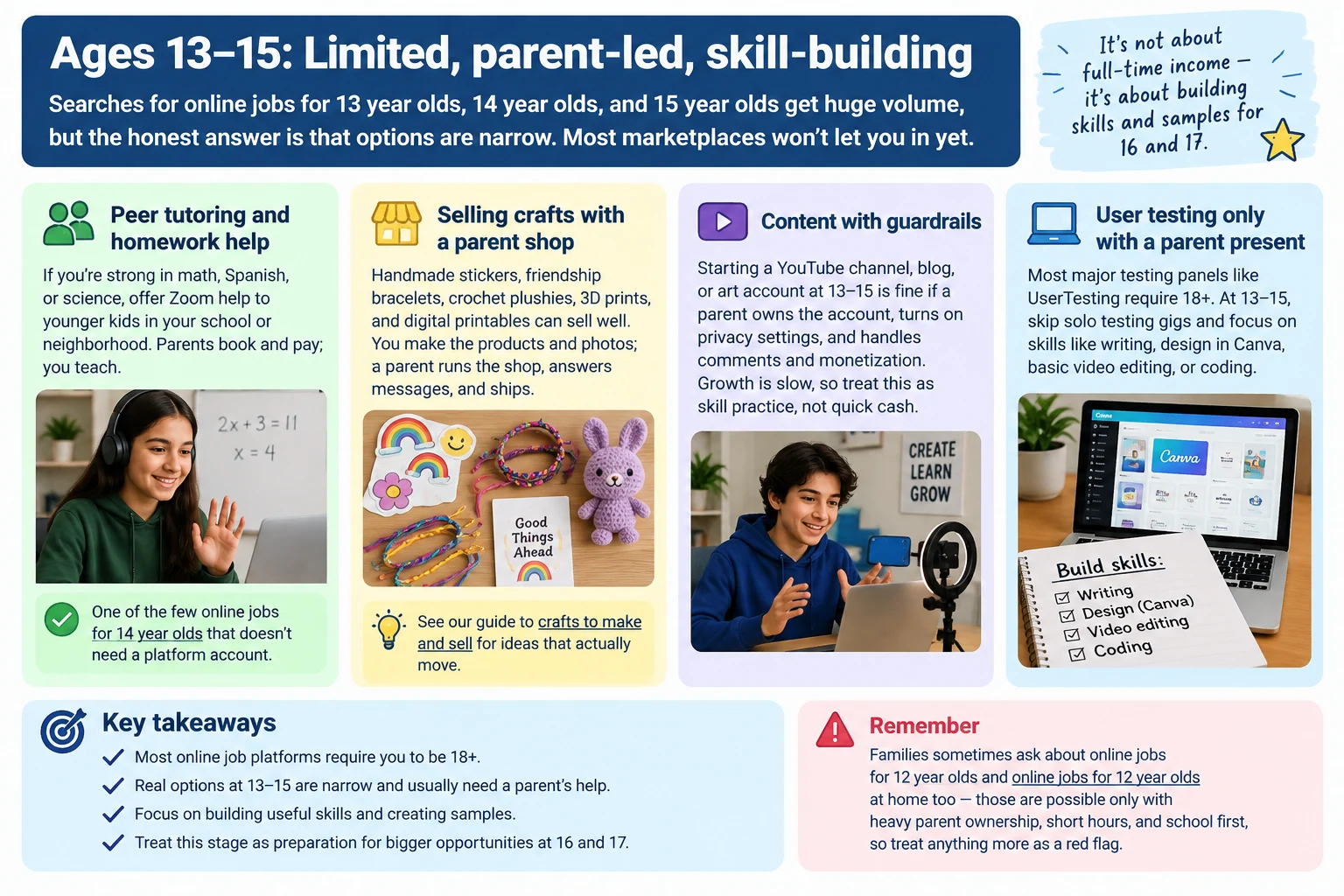 At 13-15, the winning setup is parent-owned accounts and supervised skill practice — not solo marketplace sign-ups.
Ages 16-17: Broader, Still Filtered
This is where online jobs for 16 year olds and online jobs for 17 year olds start to open up — but still not as wide as ads suggest.
Many freelance sites still require 18, even if you’re otherwise ready. That’s frustrating when you’re trying to find online jobs for 17 year olds at home that fit around school and sports. We hear the same complaint from readers at 17: local stores will hire, but online platforms lag behind.
Options that tend to work better at 16-17:
Freelance basics through parent or teen-friendly sites. General marketplaces are mostly 18+. Only use a parent-owned account where the platform explicitly allows it (for example, Fiverr with parent ownership plus disclosure, or Etsy with parent ownership) — don’t operate or share an adult’s Upwork account. Otherwise do freelance work for students just starting as direct-client work off-marketplace where a parent invoices. Start with one service: blog thumbnails, short-form captions, simple WordPress updates, or Discord moderation for small creators with parent visibility into servers and DMs. Keep jobs small, get testimonials, save every sample.
Writing is a strong entry point because you don’t need expensive gear. If you enjoy it, learn how to get paid to write online with pitches, revised drafts, and clear deadlines — skills that transfer to any later remote work.
Tutoring peers and younger kids. At 16-17 you can join some tutoring marketplaces with parent consent, or stay independent and find clients through school, church, and parent Facebook groups. SAT prep, algebra, chemistry, and beginner guitar or piano lessons all do well over Zoom.
Video editing, design, and social help for local businesses. Small shops often need help trimming Reels, updating Google profiles, or making flyers. You meet in person once with a parent, then do the online work for teens portion from home. Get paid by check, bank transfer, or a parent-to-parent payment in the parent’s name — not gift cards (most peer-payment apps also require 18+).
Selling digital products. Printables, study guides, Notion templates, Lightroom presets, and Roblox or Minecraft builds can sell if you already have an audience. A parent still needs to own the store and handle payouts until you’re 18.
Content creation with a plan. If you’ve been posting since 14-15, 16-17 is when affiliate links, digital products, or ad revenue might start trickling in. Don’t quit a steady local job to chase it, though.
Parents often ask what jobs hire at 17 online without a parent co-signing everything. The short answer: very few reputable ones. Even teen-friendly companies usually need ID verification and a guardian on file. Build now, and plan your switch-over at 18.
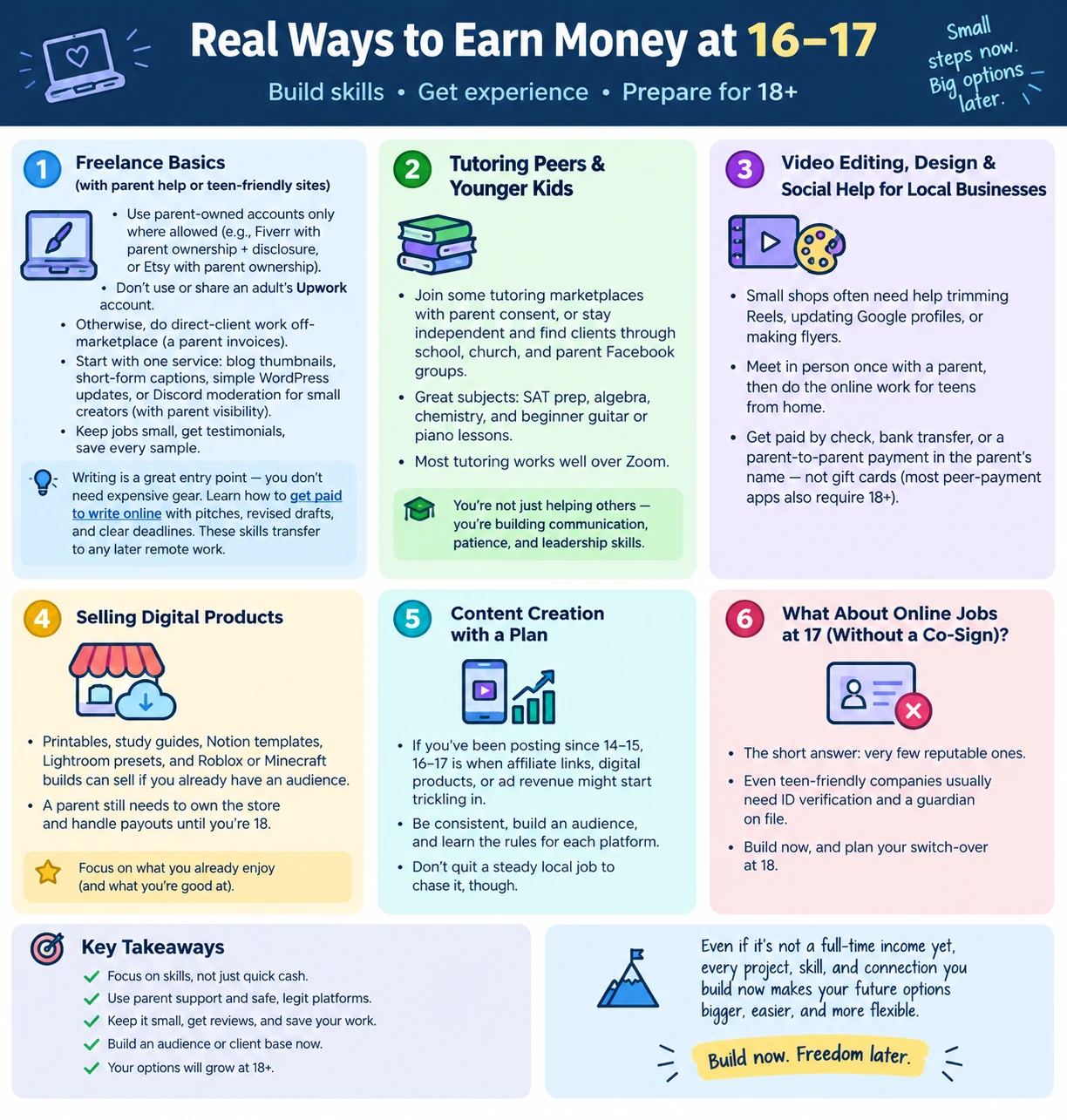 At 16-17, freelance basics, tutoring, and local-business content work open up — still under parent cover on the money side.
Age 18: The Switch-Over
Searches for online jobs for 18 year olds look similar, but the rules change overnight. At 18 you can open your own marketplace, survey, testing, and payment accounts, subject to each app’s ID, background-check, and — for delivery — driving-age rules.
That doesn’t mean you should join everything. When we review remote jobs for teens turning 18, we still tell new adults to pick one lane for 60-90 days — writing, design, editing, tutoring, or customer support — and ignore the rest. Spreading across ten low-pay apps just burns you out.
If you’re 17 now, use the last few months before 18 to build a portfolio: 3-5 writing samples, 3 edited videos, a simple portfolio page, and two references from teachers, coaches, or local clients. You’ll start at 18 ahead of most beginners.
Across all these ages, online work for teens works best when you treat it like an apprenticeship. Learn a sellable skill, get supervised reps, then monetize more independently as age limits lift.
Hybrid ApproachGood In-Person Pairings When Online Is Limited
When online doors are closed by age, pairing a small online skill with local work often pays better than chasing another app.
Think of it this way: online jobs for teenagers are constrained by platform rules, but neighborhood demand isn’t.
A few combos we see work well:
Yard Work + Canva Flyers
You mow, rake, or pet-sit locally, but you make your own flyers, Google Business posts, and before-and-after photos. You learn marketing while you earn.
Retail or Food Job + Skill Practice
A steady after-school job covers baseline cash. Nights or weekends go to writing, editing, or coding practice that becomes online jobs for 17 year olds later.
Babysitting + Virtual Homework Help
Parents who trust you in person will often pay for Zoom tutoring during the school year. Same trust, no new platform needed.
Craft Fairs + Online Shop
Sell in person at school markets or local fairs first to see what moves, then list winners online under a parent’s account.
This hybrid approach also answers the parent question behind “get money online for teens” searches. Most families don’t actually need a fully online income at 14. They need safe, supervised earning that doesn’t wreck grades or sleep. A local job two afternoons a week plus one online skill often beats five sketchy apps.
If local stores are hiring, take the interview. Cashiers, baristas, lifeguards, referees, and grocery clerks hire teens far more consistently than any online platform. You can revisit online options at 16, 17, and 18 with experience and references.
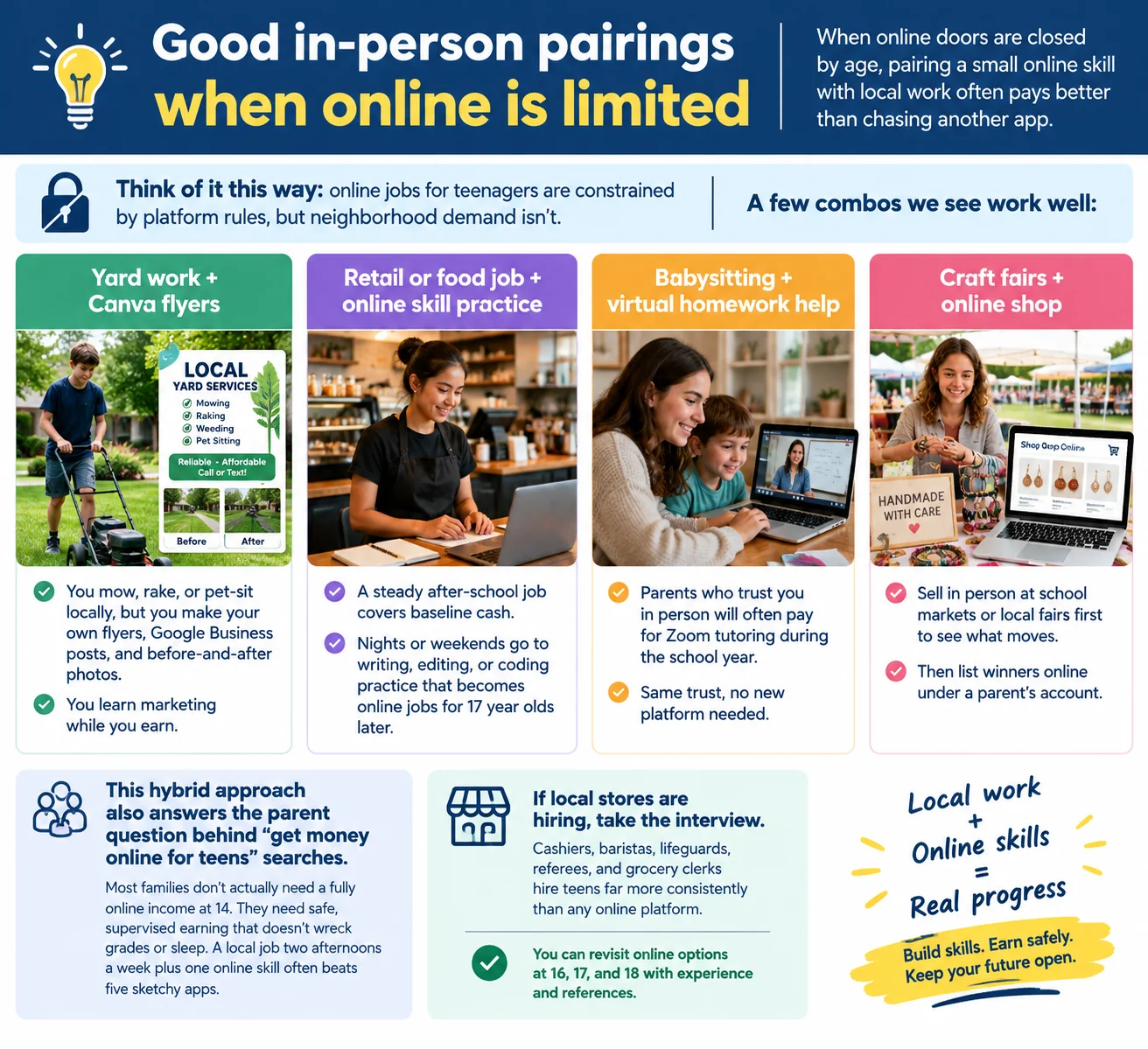 Local work plus one online skill beats five sketchy apps — neighborhood demand isn’t limited by platform age rules.
Scams Aimed at Teens and How to Spot Them
Teens are prime targets because scammers know you want experience, may not have a bank account yet, and might not tell a parent right away. When you search for online jobs for teens or remote jobs for teens, assume the top ads need extra scrutiny.
Watch for these patterns:
Know the Warning Signs
A simple safety checklist helps:
Never send ID, bank logins, or intimate photos to get a job.
Keep all communication where a parent can see it until you’re 18.
Use a parent’s payment account, not friends’ accounts.
Search “[company name] + scam + teen” before signing up anywhere.
If it feels rushed or secretive — “don’t tell your parents” — it’s not legit.
Parents: stay in the loop without taking over completely. Let teens draft pitches and do the work, but you handle contracts, payments, and any video calls with strangers.
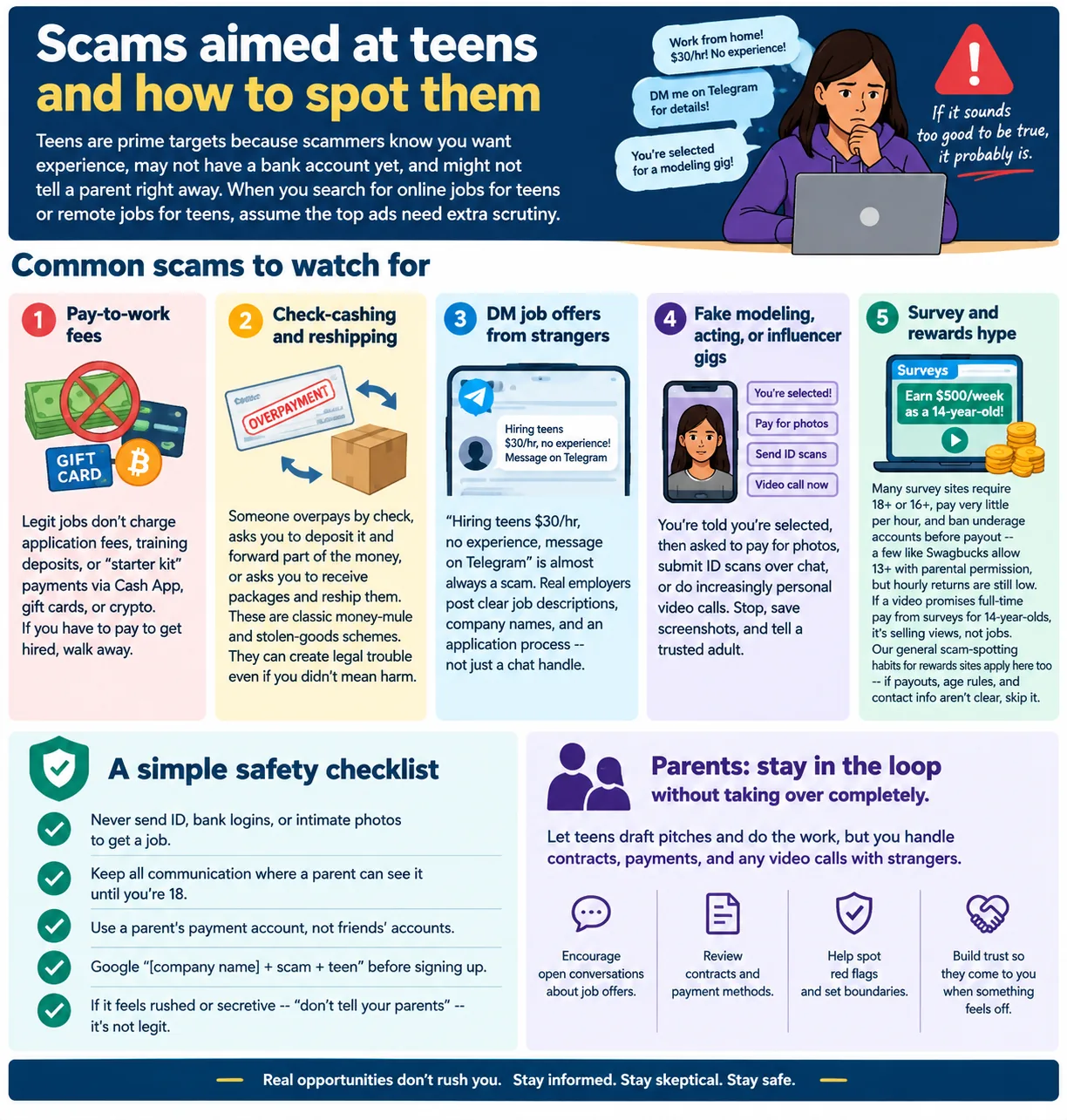 Upfront fees, check-forwarding, and Telegram-only offers — the teen scam playbook hasn’t changed, only the platforms have.
What to Focus on at Each Age
The filter is the same whether families call it online jobs for youth, online jobs for teens at home, or online jobs for kids: age, parent involvement, and whether money flows through an adult account.
If you’re asking how can teens make money online without breaking platform rules, start with supervised skill work. Peer tutoring, editing for local shops, and crafts under a parent shop beat another signup sprint. The same applies if you’re wondering how to make money as a teen online or how to make money as a teenager online — pick one skill, get three supervised reps, then expand.
At 15
Work for 15 year olds online usually means tutoring younger kids over Zoom, helping with social posts for a family business, or selling made goods through a parent storefront. When families ask about online jobs for 15 year olds at home that pay, we give the same answer: yes, but the parent owns checkout and taxes.
At 16
Remote jobs for 16 year olds and work from home jobs for 16 year olds open a little wider: weekend tutoring blocks, online jobs for 16 year olds at home for a local business, and online jobs for teens part time around school. With no portfolio yet, target no-experience roles like basic caption cleanup, thumbnail swaps, or study-guide formatting — small, defined, and easy for a parent to review. Favor direct clients you know over open marketplaces.
At 17
Work from home jobs for 17 year olds look a lot like 16 but with more hours. Online jobs for 17 year olds at home no experience still need guardian sign-off on most legit sites, so keep the parent-owned payment path until 18. Right before senior year, build the bridge: two references, three samples, and one client you can name.
At 18
Online jobs for 18 year olds with no experience finally unlock adult marketplaces — but don’t join ten at once. Pick one lane for 60 days and track it.
FAQ: Online Jobs for Teens
Online jobs for teens are real, but they run on age rules. Under 16, keep it parent-led and skill-building. At 16-17, add direct clients and local business work while a parent owns the money. At 18, the platforms open up — pick one lane and go. Whatever the age, no legitimate gig charges you to start.
Related Resources

Track Every Teen Gig in One Place
Log the applications, follow-ups, and payouts so nothing falls through the cracks. Our free Side Hustle Toolkit helps families keep parent-owned accounts, samples, and client notes organized.
Get the Free Chrome Extension